





A New Look at an Old Planet
The long-held debate over whether Mars hosted ancient oceans has gained significant new evidence. Using topographical data gathered by orbiters like NASA's Mars Global Surveyor, scientists have identified a feature that strongly resembles a continental
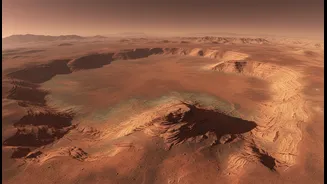
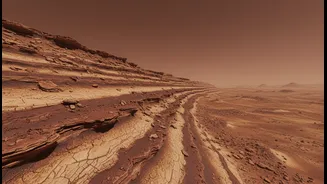
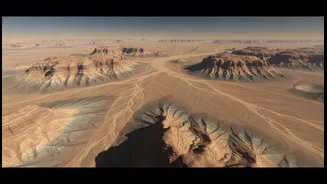
shelf. On Earth, these shelves are the submerged edges of continents, and their presence is a defining characteristic of our oceans. Researchers from institutions like Caltech found a wide, relatively flat belt of relief in Mars' northern hemisphere that mirrors these terrestrial structures. This finding is not based on a single image, but a comprehensive analysis of the planet's surface elevations, allowing scientists to see the bigger picture of a landscape shaped by processes that may have taken millions of years. The feature has been compared to a giant "bathtub ring," marking where land met a massive, stable body of water.
Tracing the Ancient Coastline
The idea of a Martian ocean isn't new, but previous searches for a consistent shoreline were complicated by features that appeared at varying elevations. This made it difficult to prove they were all part of a single, level ocean. The new research offers a breakthrough by identifying a Martian equivalent of a coastal shelf. This landform, created by the deposition of river sediments and the action of waves over a vast period, provides a more robust marker for an ancient sea than a simple shoreline, which can be altered by later geological activity. The data ties together several other pieces of evidence, including ancient river deltas that appear to feed into this proposed ocean basin. These deltas, the fan-shaped deposits where a river meets a larger body of water, line up with the newly identified shelf, creating a cohesive picture of a planet-wide water system.
Meet Oceanus Borealis
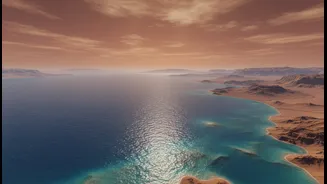
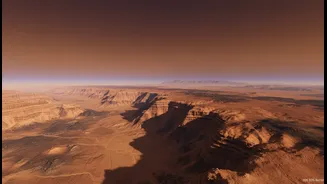
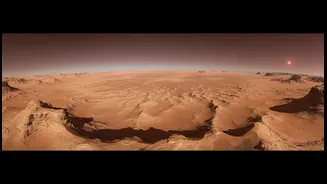
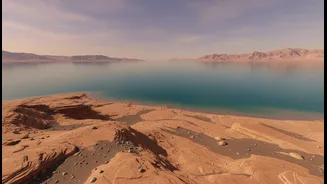
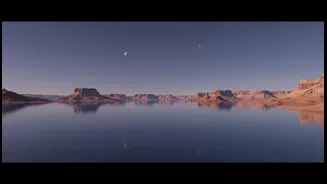
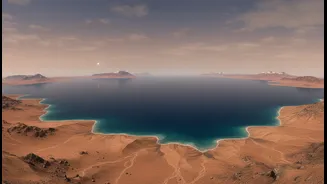
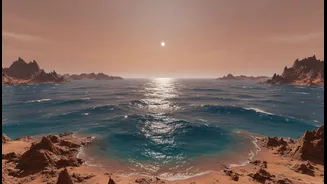
If this ocean existed, what was it like? Scientists have dubbed the hypothetical body of water Oceanus Borealis, or the Northern Ocean, as it would have filled the vast northern lowlands known as Vastitas Borealis. This basin lies several kilometers below the planet's average elevation, making it a natural collection point for water. Studies suggest the ocean could have covered up to a third of the Martian surface. For perspective, that would be an ocean roughly the size of Earth's Arctic Ocean. It would have been a central feature of a much warmer and wetter Mars around 3.7 billion years ago, a planet with a thicker atmosphere capable of supporting liquid water on its surface. While the water has long since vanished — either frozen underground or lost to space — the geological imprint remains.
The Search for Ancient Life
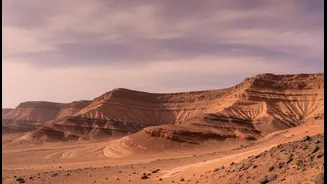
The confirmation of a long-lived, stable ocean on Mars has profound implications for the search for extraterrestrial life. On Earth, life is inextricably linked to water, and coastal areas are teeming with biological activity. If Mars ever hosted life, the sedimentary deposits along these ancient coastlines would be the prime location to look for fossils or other chemical biosignatures. Just as our own coastal sediments preserve a rich fossil record, the remnants of the Martian ocean could hold the key to understanding if the Red Planet was ever a living world. These new findings provide future rover and human missions with a much clearer target. Instead of searching vast regions, scientists can now focus on these specific paleo-shorelines, which are essentially treasure maps pointing to the most promising locations for astrobiological discovery.