

A Breakthrough Discovery
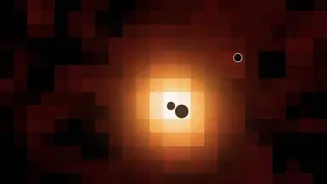
Using the James Webb Space Telescope (JWST), an international team of astronomers has identified a galaxy, known as J0148-4214, located over 12.5 billion light-years away. This means we are seeing it as it existed just over a billion years after the Big
Bang. Inside this ancient galaxy, they found compelling evidence of three supermassive black holes all actively feeding on surrounding gas and dust. This is the first time a trio of active black holes has been found in one galaxy in the distant universe.
Cosmic Hunger and Crowding
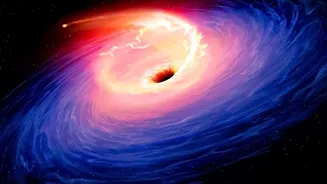
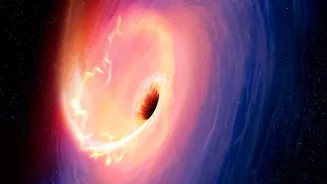
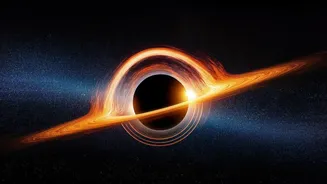
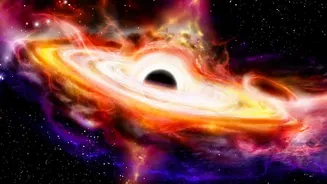
The term 'accreting' means these black holes are in the process of consuming vast amounts of matter from a disk swirling around them, which causes them to release immense energy and become visible to telescopes like the JWST. While most large galaxies, including our own Milky Way, have a single supermassive black hole at their core, finding three together is highly unusual. This discovery strongly suggests that the galaxy is the product of multiple galactic mergers, a process where galaxies collide and combine, bringing their central black holes along for the ride.
An Unusually Close Pair
What makes this discovery particularly exciting is the proximity of two of the black holes. They are separated by a projected distance of only 190 parsecs. A parsec is a unit of distance used in astronomy, equivalent to about 3.26 light-years. So, while still a vast distance, this is an incredibly close separation for two supermassive black holes on the path to merging. The third black hole is located further out, about 1.7 kiloparsecs (or 5,500 light-years) from the central pair. This configuration provides a rare snapshot of an intermediate stage in a galactic merger.
Solving a Cosmic Riddle
One of the biggest puzzles in modern astronomy is how supermassive black holes grew to be so enormous so quickly in the early universe. While they can grow by steadily consuming gas, that process alone is often considered too slow. This finding provides direct evidence for another, much faster growth method: mergers. When galaxies collide, their black holes sink toward the new center and eventually merge, combining their masses. Finding a triple system like J0148-4214 shows that these hierarchical mergers were likely common and efficient in the universe's youth.
Listening for Cosmic Ripples
The eventual collision of supermassive black holes is predicted to be one of the most violent events in the universe, sending powerful ripples through the fabric of spacetime known as gravitational waves. Current detectors are sensitive to waves from smaller, stellar-mass black hole mergers. Detecting the low-frequency waves from supermassive mergers will require future space-based observatories like the Laser Interferometer Space Antenna (LISA). Discoveries like the trio in J0148-4214 help astronomers predict what these future signals might look like and confirm that such monumental events are waiting to be observed.