



A Frozen Library of Solar System History
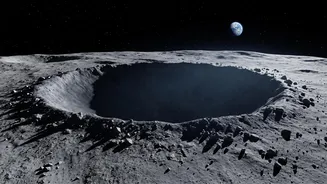
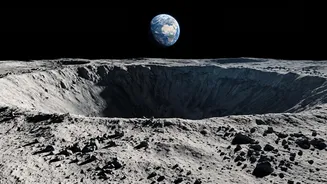
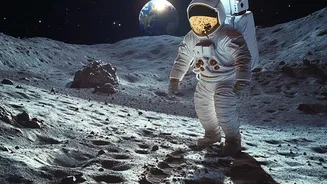
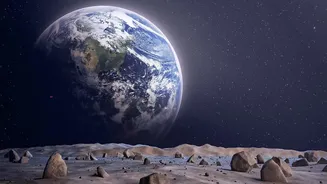
The primary target for the Artemis missions is the Moon's south pole, a region of intense scientific interest. Unlike the equatorial areas visited by Apollo astronauts, the poles contain permanently shadowed regions (PSRs). These are craters and depressions
so deep and angled that they haven't seen direct sunlight in potentially billions of years. Because of this, they are incredibly cold, acting as natural freezers. Scientists believe these PSRs have trapped water ice, a resource vital for future long-term missions. But this ice is more than just a potential resource; it's a pristine archive. Frozen within it could be clues about the formation of the solar system, the origin of water, and even the chemical precursors to life. Finding these molecules would be a monumental discovery, but only if we can be sure they are genuinely lunar.
Earth's Toughest Stowaways
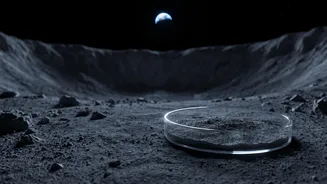
Planetary protection specialists aren't worried about common germs. They're concerned about extremophiles—hardy microorganisms that can survive incredible hardships. Humans are covered in microbes, and it's impossible to build a perfectly sterile spacecraft or spacesuit for astronauts. Recent NASA-led studies have shown that some of these tiny hitchhikers, like the fungus Aspergillus niger (a type of black mold) and certain bacteria, could likely survive on the Moon. While the lunar surface is hostile, with extreme temperatures and harsh radiation, the unique topography of the polar regions offers protection. Shaded areas, even those as small as a bootprint, could provide enough shelter for these microbes to persist in a dormant, frozen state known as cryptobiosis. They wouldn't be growing or spreading, but they would be surviving.
The Risk of a False Discovery
The central problem with microbial contamination is that it muddies the scientific waters. Imagine a future mission drills into a PSR, analyzes an ice core, and finds complex organic molecules or even fossilized microbes. It would be one of the greatest discoveries in human history—unless those molecules came from a piece of dandruff from an Artemis astronaut. Forward contamination, the transfer of life from Earth to another celestial body, could lead to a false positive, destroying our ability to trust our own findings. Scientists need to establish a baseline of what contaminants we bring with us so they can distinguish between terrestrial biology and any potential native lunar chemistry. The goal is to ensure that when we search for signs of life or its building blocks, we're not just finding our own reflection staring back at us.
Protecting the Science
To address this, space agencies adhere to planetary protection policies set by the Committee on Space Research (COSPAR). For decades, the Moon was considered a low-risk environment (Category II), not requiring stringent sterilization. However, with the discovery of water ice and the focus on PSRs, these policies have been updated. Missions to the lunar poles now have stricter requirements, including the documentation of all organic materials on board. While it's impossible to bake a crewed spacecraft clean like a robotic probe, NASA and its partners are developing rigorous protocols. This includes advanced cleaning techniques, monitoring the microbes astronauts carry, and carefully planning activities to minimize disturbance in these scientifically sensitive zones. The goal isn't to achieve perfect sterility, which is impossible with human missions, but to understand and catalogue what we bring so it can be accounted for in future analyses.