







The Groundwork for Space Internet
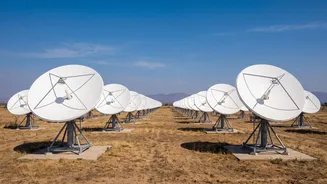
In a significant announcement at the India Mobile Congress 2026, a top SpaceX executive confirmed the completion of major ground infrastructure. Lauren Dreyer, Vice President of Starlink Business Operations, stated that 20 gateway sites, equipped with
hundreds of antennas, are now in place. These gateways are not just dots on a map; they are the essential link between Starlink's satellites in low Earth orbit and the terrestrial internet. All data traffic from Indian users will pass through these local stations, a key requirement for regulatory and security compliance. This massive investment shows Starlink is not just testing the waters but has built a foundation to serve the Indian market as soon as it receives final clearance.
Navigating India's Regulatory Maze
Building infrastructure is only half the battle. Starlink's journey in India has been a multi-year effort to navigate a complex regulatory environment. The company has secured a crucial Global Mobile Personal Communication by Satellite (GMPCS) license, but it is still awaiting final government approvals, including spectrum allocation and security clearance, before it can begin commercial operations. Dreyer emphasized that Starlink has specifically designed its operations to meet Indian security requirements, including a commitment to keep all Indian user data within the country's borders. This proactive compliance, developed over five years of discussions with regulators, is aimed at smoothing the path for the final green light. Recently, Elon Musk himself has voiced frustration over delays, alleging that powerful 'oligarchs' are attempting to block the company's entry to protect their market share.
A New Hope for Digital Bharat?
The primary promise of Starlink is not to compete with cheap fiber plans in Mumbai or Delhi, but to connect the unconnected. Satellite broadband is uniquely positioned to serve remote, rural, and topographically challenging areas where laying fibre optic cables is economically unviable. With a significant portion of India's rural population still underserved by high-speed internet, Starlink could be a game-changer for everything from education and healthcare to local economies. Officials from several states, including Maharashtra, Gujarat, and Meghalaya, have already signed letters of intent, signaling their interest in using the service to bridge the digital divide once it's authorized. Dreyer stated the company is ready to help achieve Prime Minister Narendra Modi's vision of 100 percent connectivity throughout India.
The Jio and Airtel Challenge
Starlink will not be entering an empty market. India's telecom space is dominated by Reliance Jio and Bharti Airtel, who together command a vast majority of the broadband market. After initially opposing Starlink's entry, both giants have reportedly signed Memorandums of Understanding (MoUs) with the company, shifting from a competitive to a collaborative stance. This suggests they may act as distributors or partners, integrating Starlink's satellite backhaul to extend their own networks into difficult-to-reach areas. However, the biggest hurdle remains price. Indian broadband is among the cheapest in the world, with plans starting from a few hundred rupees. While official Indian pricing for Starlink hasn't been announced, global prices are significantly higher, making it a premium service unless bundled or subsidized through partnerships with local telcos.