



The Billion-Dollar Throwaway
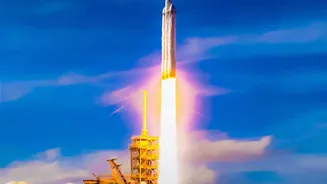
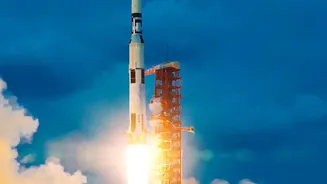
Imagine buying a brand-new airplane, using it for one flight, and then letting it crash into the ocean. This was the standard operating procedure in the space industry for over 60 years. Since the dawn of the Space Age, rockets have been expendable launch
vehicles (ELVs). Each mission required a new, custom-built machine, with the most expensive components—the powerful first-stage boosters and engines—discarded as debris after lifting their payload towards orbit. The sheer cost of manufacturing this precision hardware for every single launch made space exploration and commercialization prohibitively expensive. The fuel for a launch is a surprisingly small fraction of the total cost; the real expense is in the hardware, engineering, and infrastructure. This one-and-done model meant that launch costs often ran into the hundreds of millions of dollars, limiting space access to governments and large corporations with colossal budgets.
A Paradigm Shift in Engineering
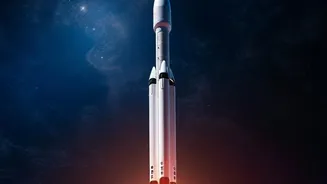
The game changed when private companies began to seriously tackle the challenge of reusability. Spearheaded by SpaceX, engineers developed the technology for a rocket's first stage to not only survive its fiery ascent but to return to Earth for a controlled, vertical landing. This feat is achieved through a combination of sophisticated technologies, including onboard guidance systems, steerable grid fins for atmospheric control, and engines that can reignite to slow the booster's descent for a soft touchdown on land or a drone ship at sea. This breakthrough, first accomplished with an orbital-class rocket in 2015, proved that the most valuable part of the rocket could be recovered and flown again, turning a disposable asset into a reusable one. This shift has been followed by other key players, including Blue Origin and Rocket Lab, who are developing their own methods for rocket recovery and reuse.
The Economics of a Second Flight
The financial implications of reusability are staggering. A new Falcon 9 rocket from SpaceX is advertised at around $67 million per launch, while competitors using traditional expendable rockets can charge over $100 million. By reusing the first-stage booster, which accounts for a significant portion of the rocket's manufacturing cost, companies can slash the price per launch. Refurbishing a booster for another flight costs a fraction of building a new one, allowing these savings to be passed on to customers. This has dramatically lowered the cost per kilogram to send a payload into low-Earth orbit, dropping from over $10,000 a decade ago to around $2,500 or less today, with projections suggesting it could fall even further. The increased reliability of flight-proven hardware has also led to lower insurance premiums for missions using reusable rockets.
The Other Side of the Debate
However, the path to reusability isn't without its own set of challenges and costs, forming the core of the ongoing industry debate. Developing reusable technology requires massive upfront investment in research and development, which can be 30-40% higher than for expendable systems. Furthermore, reusability comes with a performance penalty; a rocket must reserve a significant amount of propellant for its landing maneuvers, which reduces the total payload mass it can carry to orbit. This means for very heavy payloads or deep-space missions, an expendable rocket might still be necessary. There are also the operational costs of recovery, inspection, and refurbishment between flights. For reusability to be economically viable, a high launch frequency is essential to spread these fixed costs across many missions. A reusable rocket that only flies a few times a year may not be more cost-effective than its expendable counterpart.
Unlocking a New Era in Space
Despite the hurdles, the dramatic reduction in launch costs is undeniably fueling a new commercial space economy. Affordable access to orbit has made massive satellite mega-constellations like SpaceX's Starlink not just possible, but economically feasible, aiming to provide global internet coverage. It enables more frequent scientific missions, national security applications, and paves the way for emerging industries like in-orbit manufacturing and space tourism. Ambitious programs like NASA’s Artemis missions to the Moon are also dependent on the cost efficiencies offered by reusable rockets for their long-term goals. By fundamentally changing the cost equation, reusability is turning space from a government-dominated frontier into a dynamic arena for commercial enterprise and innovation.