




The Sun’s Familiar Heartbeat
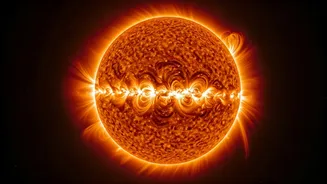
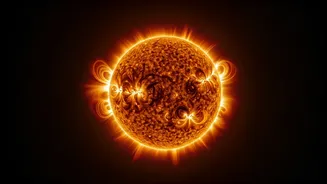
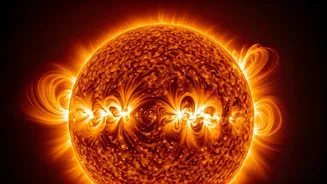
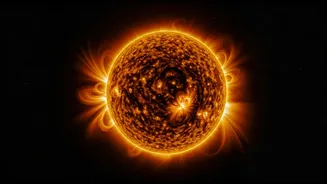
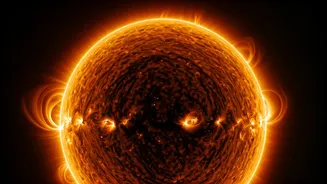
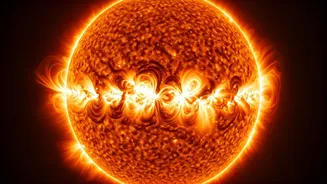
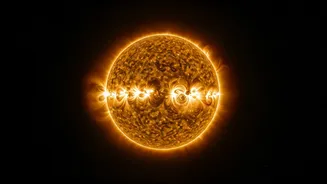
For as long as we have observed it, the sun has followed a reliable pattern. Roughly every 11 years, it moves from a quiet phase to a turbulent one and back again. This is known as the solar cycle. During solar maximum, the sun’s surface is peppered with
dark, cool sunspots — regions of intense magnetic activity. These periods are associated with an increase in solar flares and coronal mass ejections, powerful bursts of energy and particles that can create beautiful auroras on Earth but also threaten our satellites and power grids. Conversely, during solar minimum, sunspot activity dwindles, and the sun appears calm and uniform. This predictable cycle has governed our star for centuries, a celestial clockwork that we have come to depend on.
What is a Solar Hibernation?
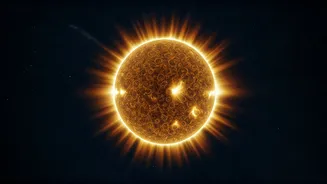
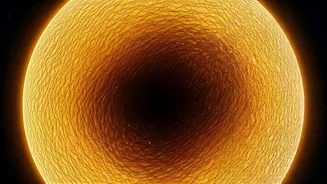
Sometimes, however, the sun deviates from its script. A 'solar hibernation,' more formally known as a Grand Solar Minimum, is a prolonged period, lasting decades or even centuries, where the sun’s activity drops to exceptionally low levels. Instead of the usual 11-year cycle, sunspots can virtually disappear for generations. The most famous example is the Maunder Minimum, which occurred between 1645 and 1715. During this 70-year span, astronomers of the era recorded a startling lack of sunspots. This period happened to coincide with the middle, and coldest part, of the 'Little Ice Age,' a time when Europe and North America experienced bitterly cold winters. While it's tempting to draw a direct line between the two, scientists today believe the relationship is complex; the cooling likely began before the Maunder Minimum, and volcanic activity also played a significant role.
The Unpredictability Problem
The core of the recent concern, as highlighted in the headline, is not just that a hibernation could happen, but that it might arrive without much of a heads-up. The 'without long warnings' aspect is what makes this a compelling scientific puzzle. Predicting the sun's behaviour is notoriously difficult. While the 11-year cycle is well-established, forecasting its strength or the potential for a long-term disruption is at the cutting edge of solar physics. Over the years, different studies and models have produced conflicting results. Some scientific models, looking at long-term magnetic field trends, have suggested that the transition into a grand minimum could be surprisingly abrupt. For instance, leading up to the current solar cycle (Cycle 25), some analyses in the early 2010s predicted it could be extremely weak, potentially heralding the start of a new grand minimum. This highlights the core challenge: we are still learning what the immediate precursors to such a dramatic shift in the sun's behaviour look like.
What Would It Mean For Earth?
If the sun were to enter a new grand minimum, it would not trigger a Hollywood-style ice age. The cooling effect from reduced solar radiation is actually quite small. Scientific models suggest it might reduce global temperatures by about 0.1 to 0.3 degrees Celsius. This would, at best, slightly slow the pace of human-caused global warming, but it would not reverse it. The impacts, however, could be more complex and regional. A less active sun can affect the chemistry of the upper atmosphere and the behaviour of the jet stream, potentially leading to colder winters in some regions (like Northern Europe and the United States) and milder ones in others. Furthermore, a weaker solar magnetic field would allow more galactic cosmic rays to enter the solar system. This increased radiation could pose a greater risk to astronauts in space and potentially affect cloud formation on Earth, a subject of ongoing research.
Is a Solar Slumber Imminent?
So, should we be preparing for a long solar nap? For now, the answer appears to be no. The predictions from over a decade ago that Solar Cycle 25 would be a dud have not come to pass. In fact, the current cycle, which began in late 2019, has been more active than many expected, defying the forecasts of a quiet sun. This doesn't mean the science was wrong, but rather that it is an evolving field with competing theories. The sun's unexpectedly vigorous activity serves as a powerful reminder of its capacity to surprise us. The scientific debate itself, between those who predicted a weak cycle and those who foresaw a strong one, underscores the very unpredictability that makes this topic so critical to study.