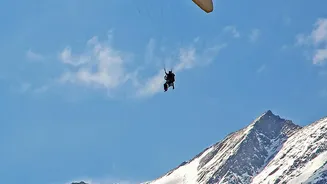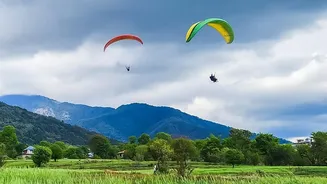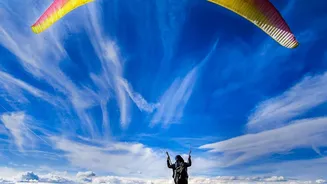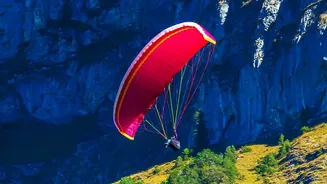



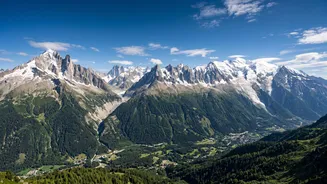
The Mountain Makes Its Own Rules
Unlike the predictable breezes you might find over flatlands, mountains create their own unique microclimates. The sheer scale of the Alps means that slopes heat and cool at different rates, air gets funnelled through valleys, and conditions can change
in an instant. What looks like a perfect, sunny day from the launch site can hide a multitude of invisible challenges just around the corner. For a paraglider, who relies entirely on air currents to stay aloft, understanding this localised weather isn't just a skill—it's a matter of survival. The interplay between the general weather system (meteo wind), sun-driven upslope breezes, and valley winds creates a complex three-dimensional puzzle that pilots must solve in real-time.
Harnessing the Power of Thermals
Thermals are the engines of paragliding. These rising columns of warm air, generated when the sun heats the ground, are what allow pilots to gain altitude and fly for hours. Sun-facing slopes, rocky outcrops, and even towns release heat, creating invisible elevators in the sky. Pilots seek out these thermals, often identified by watching birds circle upwards or by the formation of fluffy cumulus clouds at their peak. But thermals can be fickle. On hot days, they can be powerful and turbulent, demanding active piloting skills to manage. Getting into a strong thermal can feel like a rollercoaster ride, and pilots must know how to circle within its core to maximize lift without getting tossed around.
The Treachery of Valley Winds
As the mountainsides heat up during the day, the air above them rises, drawing cooler air up from the plains to replace it. This creates a 'valley wind' that flows up-valley, often in the opposite direction of the rivers. In narrow valleys, this effect is amplified—a phenomenon known as the Venturi effect—turning a gentle breeze into a powerful headwind. Pilots flying into a strong valley wind can find their progress stalled or even be pushed backward. These winds are often strongest in the afternoon and can create significant turbulence, especially where they interact with other air currents or terrain features. A key rule for mountain flying is to always have enough altitude to turn back if conditions in a valley become too strong.
Decoding the Clouds
For a paraglider, clouds are not just scenery; they are a weather forecast written across the sky. Puffy, cotton-like cumulus clouds with flat bases are generally a pilot's friend, marking the top of a good thermal. However, if those clouds start growing vertically, becoming dark and towering, they are transforming into cumulonimbus—thunderstorm clouds. These are one of the greatest dangers in aviation. Cumulonimbus clouds can create a phenomenon known as 'cloud suck', where the powerful updraft can pull a pilot upwards at an uncontrollable rate into freezing, oxygen-deprived altitudes. They also produce extreme turbulence, lightning, and hail, and are to be avoided at all costs. Lens-shaped lenticular clouds are another warning sign, indicating very strong winds at altitude.
Respecting the Foehn Wind
The Foehn (or Föhn) is a notorious wind in the Alps, a warm, dry, and incredibly gusty wind that blows down the leeward side of the mountains. It occurs when a weather system forces air over the main ridge. As the air descends, it compresses and heats up, creating clear but violently turbulent conditions. The Foehn can cause wind speeds to jump from calm to over 100 km/h in a short time, making flight impossible. Locals and experienced pilots know the signs and will not fly when a Foehn is forecast, as the chaotic 'rotor' turbulence it generates can be strong enough to cause a wing to collapse or even damage an aircraft.
Why Local Knowledge is Key
Reading a weather forecast is one thing; understanding how it will translate to a specific valley or launch site is another. This is where the wisdom of local pilots and reputable paragliding schools becomes invaluable. They possess years of experience reading the subtle signs of the local microclimate, knowing which valleys are prone to strong winds, where the best thermals are likely to be, and when it's simply time to pack up for the day. They understand that conditions that are perfect for flying in the morning can become dangerous by the afternoon. For anyone looking to fly in the Alps, respecting this local knowledge and choosing experienced guides is the most important safety decision you can make.