




A New Cosmic Category
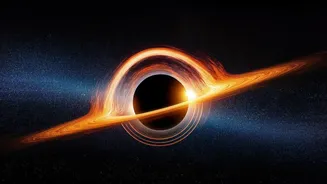
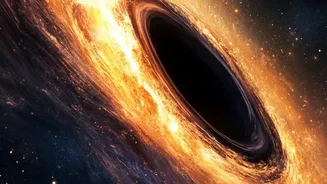
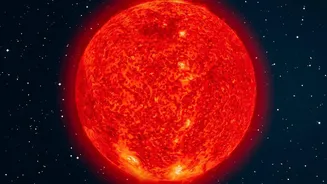
Astronomers, using NASA's powerful James Webb Space Telescope (JWST), have identified an object that blurs the line between a star and a black hole. Spotted as an intensely bright red dot in the early universe, this object has been dubbed a "black hole star."
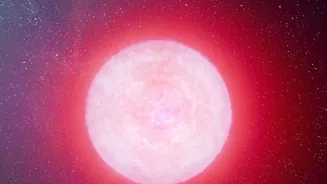
It appears to be a gigantic cloud of dense gas, roughly the size of our solar system, but it's not powered by nuclear fusion like a typical star. Instead, its immense energy seems to come from a central black hole. This discovery, published in the journal Nature, points to an entirely new type of astrophysical object that scientists have never seen before.
What Makes It So Strange?
This object, officially named MoM-BH-1, has a set of perplexing characteristics. While it has the physical appearance of an enormous star, it is producing about 100 billion times more energy than any known star possibly could. This level of energy output is more commonly associated with accreting black holes, which consume surrounding matter. Furthermore, the object's light signature is unique. It's incredibly red, which can sometimes be caused by dust, but other spectral signals didn't match that explanation. The light is extremely bright but drops off sharply at certain wavelengths, a phenomenon known as a 'Balmer break' that was the strongest ever recorded. It is also composed almost entirely of hydrogen and helium, lacking the heavier elements expected in such a massive object.
The Hunt for an Explanation
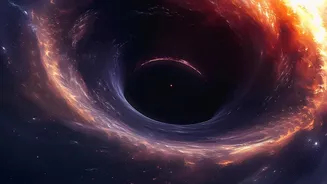
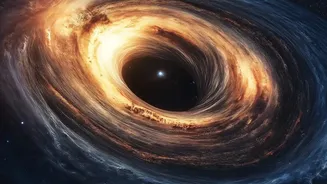
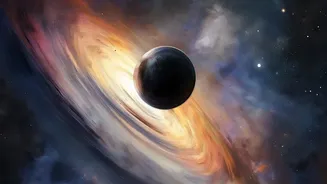
The team, led by MIT astrophysicist Rohan Naidu, initially found the object while searching for the oldest galaxies in the universe. These mysterious red dots have appeared in many JWST images, often assumed to be either very distant galaxies or objects obscured by cosmic dust. However, MoM-BH-1's unique properties ruled out these conventional explanations. Through extensive modeling and simulations, the scientists concluded the most likely scenario is a hybrid object. The model suggests a central black hole about 100,000 times the mass of our sun, which acts as the power source. This core is shrouded in a massive, dense cocoon of hydrogen gas that radiates light, making it appear like a star.
Rewriting the Stellar Playbook
The discovery of a black hole star is more than just a cosmic curiosity; it could reshape our understanding of the early universe. These objects might be a key transitional phase in the formation of supermassive black holes, which are known to reside at the center of most large galaxies, including our own Milky Way. If this model is correct, many of the other unexplained red dots seen by the JWST could also be these nascent black holes hidden within gassy, star-like envelopes. This finding provides a potential answer to the long-standing question of how supermassive black holes grew so large, so quickly after the Big Bang. It suggests they may have started life as these peculiar, oversized stellar objects, feeding on a vast reservoir of primordial gas.