




A Familiar Cosmic Laboratory
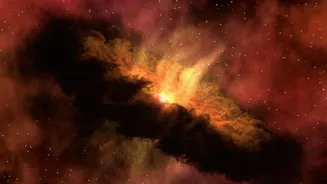
Just 63 light-years from Earth lies a star that has captivated astronomers for decades: Beta Pictoris. At only 23 million years old, it's a mere toddler in cosmic terms, making it a perfect laboratory for studying how planetary systems form. For years,
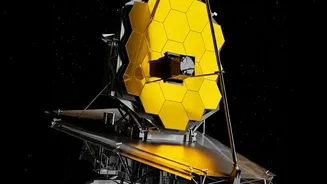
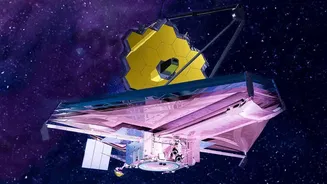
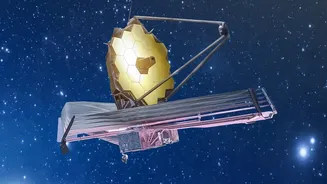
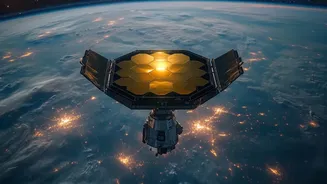
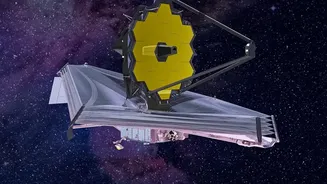
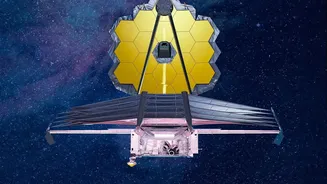
it has been known to host a massive disk of dust and debris—the raw material for planet-making—along with two giant planets, Beta Pictoris b and c. Beta Pictoris b was one of the very first exoplanets to be directly photographed, and its larger sibling, Beta Pictoris c, orbits closer to the star. This system has been a benchmark, offering a rare glimpse into the chaotic and beautiful process of a solar system coming into being. Scientists believed they had a good handle on its main inhabitants, but the James Webb Space Telescope (JWST) had a surprise in store.
The Unexpected Newcomer: Beta Pictoris d
While studying this famous system, astronomers made a serendipitous discovery: a third planet, now named Beta Pictoris d. This wasn't a case of spotting another bright point of light. The planet was hiding in plain sight, concealed within the bright glare of the system's massive dust disk. The JWST's powerful instruments, specifically the Near-Infrared Spectrograph (NIRSpec), allowed scientists to find it using an entirely new technique. Instead of taking a direct picture, Webb detected the chemical fingerprint of the planet's atmosphere, identifying the tell-tale signs of methane, carbon monoxide, and water vapor. This spectroscopic method effectively allowed astronomers to see through the cosmic fog that had hidden the planet from other telescopes for years.
Why This Discovery Is a Game-Changer
The discovery of Beta Pictoris d is significant for several reasons. Firstly, it makes Beta Pictoris only the second star system, after HR 8799, to have more than two directly imaged planets, providing a rich environment for comparative study. With an estimated mass of about two times that of Jupiter, Beta Pictoris d is the smallest of the three known giants in the system. Its existence may also solve a long-standing puzzle. Astronomers had noticed that the system's debris disk had a sharp inner edge that couldn't be fully explained by the gravitational pull of planets b and c alone. The presence of this third planet, orbiting further out, could be the missing piece that accounts for the disk's unusual structure. The find was so unexpected that after the JWST detection, scientists went back through over a decade of archival data from other telescopes and realised the planet's faint signal had been there all along, just waiting to be found.
A New Way to Find Hidden Worlds
Perhaps the most exciting aspect of this find is not just the what, but the how. Beta Pictoris d is the first planet discovered primarily through moderate-resolution spectroscopy. This demonstrates a powerful new capability for the JWST. In complex and dusty environments like young star systems, where traditional imaging can struggle to separate the faint light of a planet from the glare of its star and surrounding debris, looking for atmospheric chemical signatures offers a new path forward. This technique could transform the search for exoplanets, especially those in environments that were previously difficult to probe. It proves that astronomers can identify worlds not just by seeing them, but by analyzing the unique molecular fingerprints they leave on the light around them. As scientists continue to refine this method, it opens the door to discovering countless other hidden worlds across the galaxy.