


A Surprise in a Familiar System
The Beta Pictoris system, 63 light-years away, is a famous stellar neighbourhood known for its bright ring of dust and debris. Already home to two giant planets, Beta Pictoris b and c, it’s a prime target for studying planet formation. Recently, astronomers
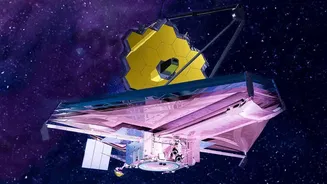
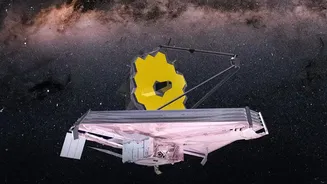
using the James Webb Space Telescope (JWST) got a surprise. While studying the known planet Beta Pictoris b, they stumbled upon an unexpected signal in their data. This serendipitous discovery revealed a third planet, now named Beta Pictoris d, hiding in a system scientists thought they knew well.
Detecting a Planet's Fingerprint
What makes this discovery revolutionary is how the planet was found. Beta Pictoris d wasn’t spotted as a tiny dot of light, the traditional method of 'direct imaging'. Instead, Webb found it by detecting its unique chemical fingerprint. The telescope’s Near-Infrared Spectrograph (NIRSpec) analysed the light from the system and picked up the tell-tale signs of methane and water vapour in a specific location. This atmospheric signature confirmed the presence of a planet that had been concealed from other telescopes for years within the system’s bright, dusty disk.
The Power of NIRSpec
The instrument behind this discovery, NIRSpec, is a scientific marvel. It’s a spectrograph that breaks down light into its component wavelengths, like a prism creating a rainbow. It uses an Integral Field Unit (IFU) to capture a spectrum for every single pixel in its field of view. Instead of just a picture, astronomers get a 'data cube' packed with chemical information. This allowed them to distinguish the chemical makeup of the planet’s atmosphere from the surrounding dust and starlight. It was this incredibly detailed map that gave away the location of the hidden world.
Meet Beta Pictoris d
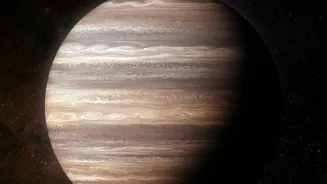
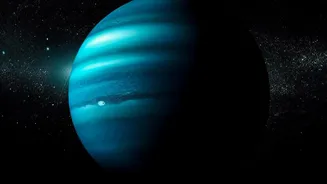
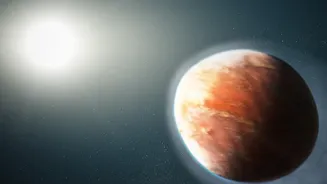
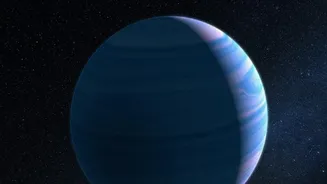
The newfound world, Beta Pictoris d, is a gas giant similar to Jupiter. Current estimates place its mass at two to four times that of Jupiter, making it the smallest of the three known planets in the system. It follows a wide orbit roughly comparable to Neptune’s in our solar system, placing it just inside the star's massive debris disk. This location is partly why it was so difficult to spot using conventional imaging methods. For over a decade, this world was playing cosmic hide-and-seek, waiting to be found.
A New Chapter in Planet Hunting
The confirmation of Beta Pictoris d is more than just another exoplanet discovery; it heralds a new technique in the search for alien worlds. It is the first time a planet has been found primarily through moderate-resolution spectroscopy. This method proves astronomers can now identify planets by their atmospheric composition, even in cluttered environments where direct imaging fails. It is a game-changer for finding worlds too faint or too close to their stars to be seen otherwise, proving Webb can discover planets, not just study them.
Collaboration and Confirmation
Adding weight to the discovery, an independent team of astronomers confirmed the planet's existence using the European Southern Observatory's Very Large Telescope in Chile. In a remarkable piece of astronomical detective work, they even found faint traces of the planet in archival data stretching back more than ten years. This dual confirmation from separate teams using both space and ground-based observatories provides rock-solid evidence of the new world.