
A World of Extremes
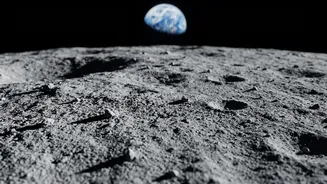
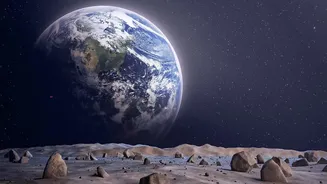
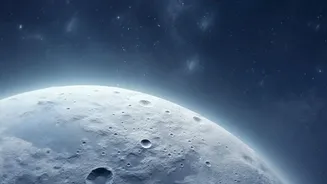
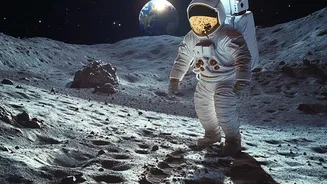
For life as we know it, the lunar surface is an almost impossibly hostile place. With virtually no atmosphere to act as a shield, it's a world of punishing extremes. During the long lunar day, which lasts about two Earth weeks, sunlit areas can reach
a scorching 127°C. Then, during the equally long night, temperatures plummet to a bone-chilling -173°C. On top of that, the surface is constantly bombarded with deadly ultraviolet (UV) radiation from the sun and high-energy cosmic rays from deep space, which would shred the complex molecules necessary for life. For decades, these conditions led most scientists to believe that nothing could survive there.
Islands of Eternal Twilight
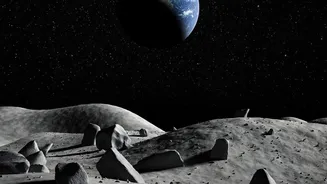
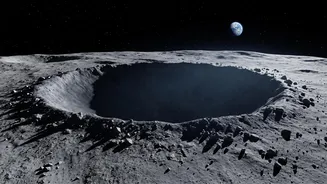
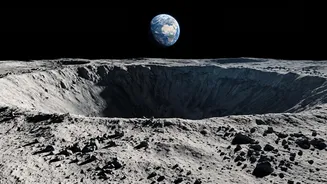
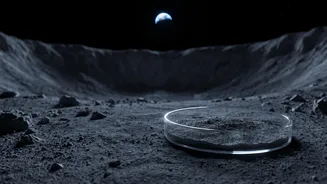
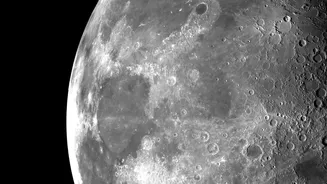
The game changes at the Moon's north and south poles. Because the Moon has a very slight axial tilt, the sun at the poles never rises high in the sky; instead, it hovers just above the horizon. This low-angle sunlight means that the rims of craters, hills, and even small bumps can cast long, permanent shadows. These areas, known as Permanently Shaded Regions (PSRs), have not seen direct sunlight for potentially a billion years or more. They are some of the coldest places in our solar system, with temperatures that can dip below -200°C. For a long time, these were just considered cold, dark oddities. Now, scientists see them as potential sanctuaries.
How Shade Creates a Refuge
The primary benefit of these shaded regions is protection. The deep, permanent darkness acts as a natural shield, blocking the intense UV radiation that sterilizes the rest of the lunar surface. This is crucial because UV light is the main threat to microbial survival in these polar regions. The extreme and stable cold also plays a vital role. It is cold enough to trap water molecules as ice, which could be a critical resource. While it's too cold for life to be active, the stable, frigid conditions are perfect for preservation. In these shielded niches, fragile molecules and dormant microorganisms could be protected from the destructive forces outside.
Earth's Toughest Survivors
To understand what might survive on the Moon, scientists look to Earth's most resilient organisms: extremophiles. These are microbes that thrive in conditions that would kill most other life forms, from the crushing pressures of deep-sea vents to the toxic acidity of mine drainage and the intense cold of Antarctic deserts. Recent NASA studies have focused on microbes commonly found on spacecraft and human explorers. Organisms like the fungus Aspergillus niger (a type of black mold) and bacteria such as Deinococcus radiodurans are remarkably tough. Aspergillus niger, for example, has thick, dark walls that protect it from radiation and has even survived experiments on the outside of the International Space Station.
New Possibilities for a 'Dead' World
Recent models have combined data on lunar terrain with the known survival limits of these hardy microbes. The results, published in Science Advances, revealed that significant parts of the lunar poles could be amenable to microbial survival. These "survivable niches" range in size from vast crater floors to something as small as an astronaut's bootprint. In these protected spots, microbes wouldn't be able to grow or reproduce, but they could persist in a dormant state for days, weeks, or even longer. The Aspergillus fungus proved to be a champion, able to survive for at least seven days in some shaded areas. This doesn't mean life exists on the Moon now, but it suggests that if microbes ever hitched a ride from Earth on a meteorite or a spacecraft, their story might not have ended on impact.