


A Cosmic Misalignment
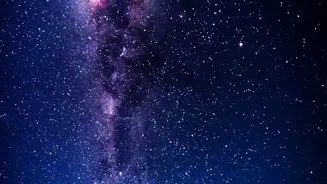
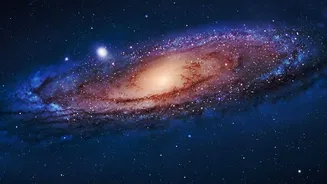
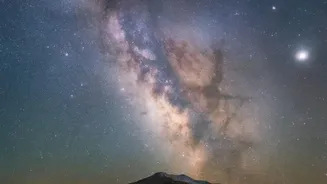
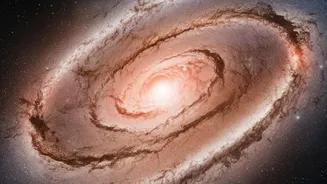
Imagine the Milky Way as a vast, spinning vinyl record, with spiral arms full of stars, gas, and dust. For the most part, it's a relatively flat disk. However, astronomers have long been perplexed by the galaxy's stellar halo—a sparse, spherical cloud
of ancient stars that surrounds the main disk. While stars in the disk zoom around the galactic center at about 220 kilometers per second, the stars in the halo move much more slowly, at a mere 25 kilometers per second. This significant speed difference suggested that something dramatic must have happened in our galaxy’s history to throw things so out of sync.
The Prime Suspect: Gaia Sausage
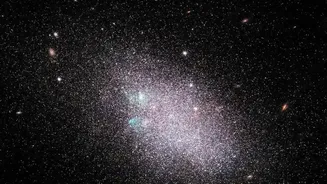
The culprit, according to recent research, was a dwarf galaxy known as Gaia-Sausage-Enceladus. The quirky name comes from data gathered by the European Space Agency's Gaia mission, which revealed that many stars in our halo travel in peculiar, elongated orbits shaped like sausages. These stars are the remnants of a dwarf galaxy that collided head-on with a young Milky Way between 8 and 11 billion years ago. Our much larger galaxy tore the intruder to shreds and absorbed most of its stars, but the encounter was so violent that it left an indelible mark. This event is considered the last significant merger in the Milky Way's history, profoundly reshaping its structure.
Reconstructing a Galactic Crime Scene
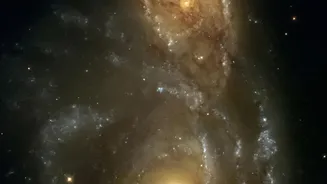
Scientists at Durham University used powerful supercomputer simulations to piece together this ancient event. They modeled how galaxies like the Milky Way evolve over billions of years and found a recurring pattern: galaxies that experienced a massive, head-on collision often ended up with a slowly rotating stellar halo. More dramatically, these collisions could cause the entire galactic disk to perform a slow-motion somersault, flipping its orientation by more than 90 degrees over hundreds of millions of years. This "disk flip" provides a compelling explanation for the puzzlingly slow halo. The collision effectively knocked our galaxy on its side, while the halo preserved the memory of the ancient cataclysm.
More Than Just a Tilt
This colossal impact didn't just reorient our galaxy; it had other profound effects. The repeated passages of another dwarf galaxy, Sagittarius, are believed to have triggered massive waves of star formation. These collisions sent ripples through the Milky Way's dust and gas, creating high-density pockets where new stars could be born. In fact, one of these star-forming episodes, occurring roughly 4.7 billion years ago, coincides with the birth of our own Sun. While it's impossible to prove a direct link, it's fascinating to consider that our solar system's existence may be a consequence of these ancient galactic battles. The collisions also likely contributed to creating the Milky Way's iconic spiral arms.
A New Chapter in Our Cosmic Story
The discovery that the Milky Way was likely flipped on its side rewrites a key chapter of our galactic history. It transforms our view of the galaxy from a static, serene structure to a dynamic and evolving one, shaped by violent encounters. According to lead researcher Kirill Batrakov, this means that most of the Milky Way's stars, including possibly our Sun, once moved on very different paths. Our seemingly stable place in the cosmos might not have been so stable throughout its entire history. This new understanding helps place the Milky Way in the broader context of other galaxies and provides a 'testbed' for understanding how galaxies across the universe are formed and shaped by mergers.