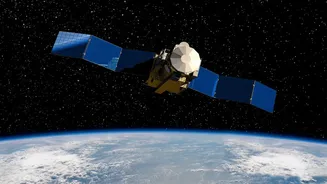










A Milestone Launch from Sriharikota
The Indian Space Research Organisation (ISRO) celebrated a landmark achievement with the successful launch of its Geosynchronous Satellite Launch Vehicle (GSLV-F17). Lifting off from the Satish Dhawan Space Centre in Sriharikota, the powerful rocket flawlessly
executed its mission, precisely deploying the EOS-05 satellite into its intended orbit. This launch was particularly significant as it was ISRO's first successful mission of 2026, ending an eight-month lull and providing a major boost to the GSLV programme after previous setbacks. The 51.7-metre-tall rocket, weighing over 420 tonnes, performed even better than expected, placing the 2,367 kg satellite into a higher-than-planned orbit, which could potentially extend the satellite's operational life.
India’s New ‘Eye in the Sky’
The payload at the heart of this mission, EOS-05, is a state-of-the-art Earth observation satellite. Described as a “strategic satellite” and an “Eye in the Sky,” it is India’s first-ever imaging satellite designed to operate from a geosynchronous orbit, approximately 36,000 kilometres above Earth. Unlike most observation satellites which are in Low Earth Orbit and pass over a location periodically, EOS-05's position will allow it to continuously monitor the Indian subcontinent. This provides a persistent watch over a large geographical area, a capability only a handful of nations possess. The satellite will provide real-time imagery, a game-changer for a variety of applications.
The GSLV: A Reliable Workhorse
The GSLV-F17 mission was the 19th flight for the GSLV rocket, a three-stage launch vehicle featuring an indigenous cryogenic upper stage. Once nicknamed the “Naughty Boy” for its early reliability issues, the GSLV has matured into a dependable launcher for ISRO. This success was crucial in rebuilding confidence in the vehicle. With this launch, the GSLV has proven its capability to lift heavy payloads, as EOS-05 is the heaviest satellite ever launched by a GSLV into a geosynchronous transfer orbit. The improved performance demonstrates ISRO's continuous efforts to upgrade the vehicle's structural and propulsion systems.
What EOS-05 Means for India
The capabilities of the EOS-05 satellite have far-reaching implications for India. Its primary civilian purpose is to provide crucial data for disaster management by enabling rapid monitoring of cyclones, floods, and forest fires. It will also greatly aid in agriculture by monitoring crop health, and in tracking climate patterns. From a strategic standpoint, the satellite significantly enhances India's surveillance capabilities. The ability to maintain a constant watch over border regions provides valuable situational awareness for national security. Furthermore, the mission reinforces the 'Aatmanirbhar Bharat' (self-reliant India) initiative, showcasing the growing partnership between ISRO and domestic industries that contributed heavily to the mission.