


The Venusian Anomaly
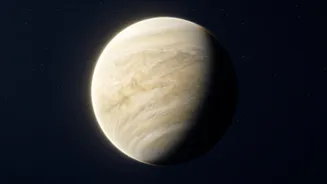
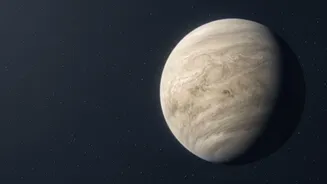
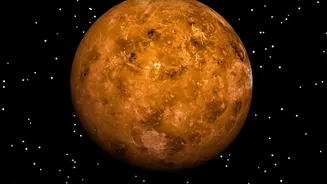
For decades, scientists have been puzzled by Venus. It shares a similar size, mass, and structure with our own planet, yet it's a world of extremes. It’s the hottest planet in the solar system, but its most baffling traits are its spin and its lack of a companion.
Venus rotates backwards compared to most other planets, and it does so at a glacial pace. A single day on Venus lasts for 243 Earth days, which is longer than its entire year. This sluggish, retrograde rotation is a core piece of the puzzle. While Earth’s quick spin helps push our Moon further away by about four centimetres each year, scientists wondered if the opposite could be true for Venus. Previous theories for its moonless state included a massive impact destroying a former moon or Venus simply never forming one in the first place. But new research suggests a more intimate, self-destructive process.
A Doomed Satellite
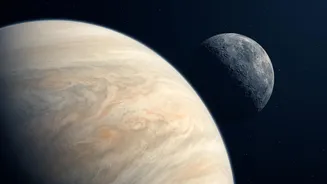
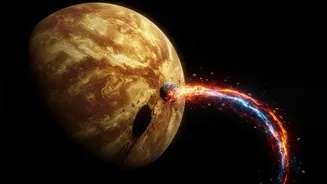
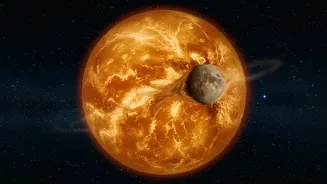
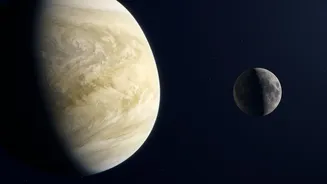
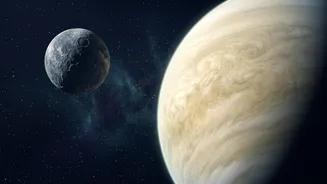
New computer simulations led by astrophysicist Stephen Kane at the University of California, Riverside, propose a fascinating, if grim, scenario. The research suggests that if Venus ever had a moon, its own slow rotation would have sealed the satellite’s fate. Kane’s models show that the planet’s immense gravity, combined with its slow spin, would create a tidal interaction that pulls a moon inward, not outward. Instead of gracefully drifting away like Earth's Moon, a Venusian moon would be caught in a death spiral, moving closer and closer until it collided with the planet. To verify their models, the researchers first successfully simulated the known evolution of the Earth-Moon system before applying the physics to Venus.
The Key Qualification
The simulations make a compelling case, but they hinge on one critical factor: the initial rotation speed of a young Venus. The headline's “main qualification” is that this inward spiral is not guaranteed. It depends entirely on how fast Venus was spinning after its formation, likely following a moon-creating impact billions of years ago. According to the models, if an early Venus had a rotation period shorter than about 12 hours, a moon could have survived. But if the initial spin was slower than that threshold, the tidal forces would have inevitably dragged the moon inward to its destruction. The simulations showed that in most scenarios with a slow-spinning Venus, the moon crashed into the planet, with larger moons falling even faster. This suggests Venus didn't need a separate, catastrophic event to lose its moon; its own rotational physics were enough.
The Aftermath of a Cosmic Crash
What would happen if a moon crashed into a planet like Venus? The impact would be cataclysmic. Such a collision would have unleashed enormous amounts of energy and momentum, profoundly altering the planet’s geology, atmosphere, and even its rotation. It’s possible that the impact itself is what caused or contributed to Venus’s current, bizarrely slow and backward spin. The event could have also triggered massive volcanic activity, contributing to a major resurfacing of the planet. This aligns with observations that about 80% of Venus's surface appears to be of a similar age, hinting at a major global event that erased older geological history. If Venus ever had conditions favourable to life, such as oceans, a moon collision would have dramatically altered its evolutionary path, likely contributing to the hellish hothouse it is today.