



The Odd Couple of Mars
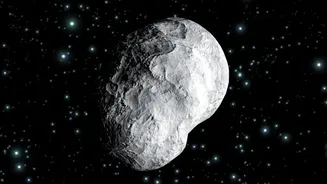
Phobos and Deimos are among the smallest moons in the solar system. Phobos, the larger of the two, is about 27 kilometres across at its widest point, while Deimos is a mere 15 kilometres. Their small size is the primary reason for their irregular, non-spherical
shapes. They simply don't have enough mass for gravity to crush them into a round form, a state known as hydrostatic equilibrium. As a result, they remain as heavily-cratered, lumpy rocks. Phobos orbits incredibly close to Mars, circling the planet three times a day, while Deimos is further out. This proximity means Phobos is slowly spiraling inward and is expected to either crash into Mars or be torn apart to form a ring in about 50 million years. Deimos, in contrast, is slowly drifting away.
A Tale of Two Theories
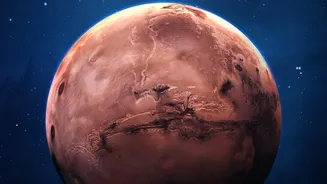
For decades, the central mystery surrounding Phobos and Deimos has been their origin. Their dark, carbon-rich composition is very similar to certain types of asteroids found in the outer solar system, which led to the leading 'capture theory'. This idea proposes that the two moons were once wandering asteroids that strayed too close to Mars and were caught by its gravity. However, this theory has a major problem: their orbits. Both moons circle Mars in a nearly perfect circular path above its equator. Captured asteroids would be expected to have much more eccentric, tilted orbits. This has given rise to a competing 'giant impact' theory. This hypothesis suggests that a massive object, perhaps a protoplanet, slammed into Mars billions of years ago. The resulting debris would have formed a ring around the planet, which then coalesced to form Phobos, Deimos, and possibly other, larger moons that have since crashed back into Mars.
What New Data Reveals
Recent observations and new studies are adding fresh layers to this debate. While Phobos is covered in craters and grooves, Deimos appears strikingly smooth. Data from a flyby by the European Space Agency's Hera mission in 2025 has provided a potential explanation. A study published in Nature Astronomy suggests a single, sub-catastrophic impact on Deimos is responsible for both a massive 10-kilometre crater and the thick layer of fine dust, or regolith, that blankets the moon, hiding older craters and giving it a smooth look. This 'rubble pile' characteristic, where the moon is essentially a collection of debris held together by gravity, could be consistent with the giant impact origin theory. The composition of this material gives scientists clues, and evidence points toward similarities with primitive asteroids, keeping both theories in play.
A Mission for Answers
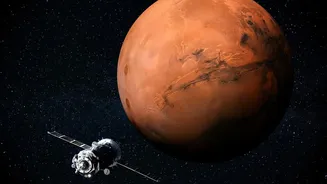
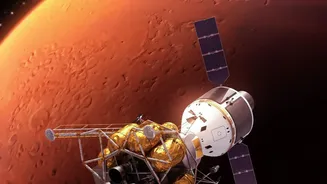
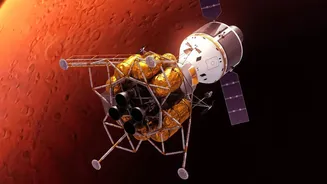
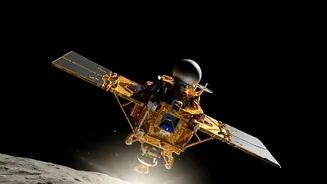
To finally solve the mystery, we need to get our hands on a piece of the moons themselves. That's the goal of the Japan Aerospace Exploration Agency's (JAXA) Martian Moons eXploration (MMX) mission, which launched in October 2026. This ambitious mission, a collaboration with NASA and other space agencies, will arrive at Mars in 2027. It will spend three years studying both moons before attempting the first-ever landing on Phobos to collect at least 10 grams of rock and dust. After collecting its precious cargo, the spacecraft will perform several flybys of Deimos for comparison before beginning its journey home, with the samples scheduled to arrive on Earth in 2031. Scientists believe these samples could contain traces of Martian rock, blasted onto Phobos by ancient impacts, giving us a two-for-one look into the history of both the moon and the Red Planet itself.