




A New Kind of Cosmic Vision
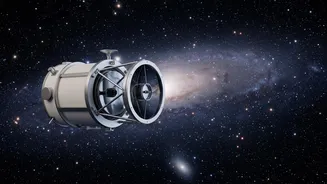
The Nancy Grace Roman Space Telescope, named after NASA’s pioneering first chief of astronomy, represents a monumental leap in how we observe the cosmos. While telescopes like Hubble and Webb provide exquisitely detailed, zoomed-in views of specific cosmic
targets, Roman is built for breadth. Its primary mission is to conduct enormous surveys of the sky, creating panoramic maps of the universe with a speed and scale previously unimaginable. Think of it this way: if Hubble and Webb are like photographers using a telephoto lens to capture a single, distant bird, Roman is using a wide-angle lens to photograph the entire forest it lives in. This approach will generate an unprecedented treasure trove of data, enabling scientists to study everything from our galactic neighbors to the fundamental structure of the universe.
The Power of a Panoramic View
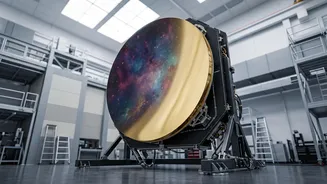
Roman's superpower lies in its Wide Field Instrument (WFI), a 300-megapixel camera that gives it a field of view at least 100 times larger than Hubble's infrared camera. Though its primary mirror is the same size as Hubble's at 2.4 meters, Roman’s advanced optics and nimble design allow it to map huge swaths of the sky with comparable sharpness. Over its five-year primary mission, Roman will observe more than a billion galaxies and is expected to collect more data than all of NASA’s previous astrophysics missions combined. This capability will allow it to conduct its High-Latitude Wide-Area Survey, which will map the positions and shapes of hundreds of millions of galaxies to create a 3D view of the cosmic web. This isn't just about taking pretty pictures; it's about building a comprehensive dataset that will fuel astronomical discoveries for decades.
Solving the Universe's Biggest Mysteries
Roman has two primary scientific goals that tackle some of the biggest questions in cosmology: understanding dark energy and discovering exoplanets. Dark energy is the mysterious force believed to be causing the universe's expansion to accelerate, and it makes up about 68% of the cosmos. By measuring the distances to millions of galaxies and thousands of distant supernovae, Roman will help astronomers trace the history of cosmic expansion with unparalleled precision, offering clues to the true nature of this strange phenomenon. Its second major task is to complete a census of exoplanets. Using a technique called gravitational microlensing, Roman is expected to find over 100,000 new planets, including small, rocky worlds and even "rogue planets" that drift through space untethered to a star. This will vastly expand our catalog of known worlds and provide critical statistics on how common Earth-like planets might be.
A Pioneer for Future Observatories
Beyond its primary surveys, Roman is also a technology pathfinder. It carries a Coronagraph Instrument, an advanced system designed to block the overwhelming glare of a star to directly image the much fainter planets orbiting it. While most exoplanets are detected indirectly, such as by the dimming of starlight, Roman's coronagraph will demonstrate techniques for taking actual pictures of Jupiter-like exoplanets. This is a crucial test for technologies that will be essential for future missions, like the proposed Habitable Worlds Observatory, which aims to one day search for signs of life on Earth-like planets around other stars. Following its successful launch on August 30, 2026, and deployment of its key systems, Roman is now undergoing its commissioning phase before beginning its historic science operations.