




A Major Martian Mystery
For decades, Phobos and its smaller sibling Deimos have puzzled scientists. They are small, potato-shaped, and pockmarked with craters. But their origin story is a huge question mark. There are two main theories: either they are asteroids captured by
Mars's gravity long ago, or they are chunks of Mars itself, blasted into orbit by a colossal impact millions of years in the past. Neither theory perfectly fits the data we have. The shape and appearance suggest they are captured asteroids, but their orbits suggest they were born from Mars. Solving this mystery is about more than just two tiny moons; it’s about understanding how planetary systems, including our own, form and evolve.
Enter the MMX Mission
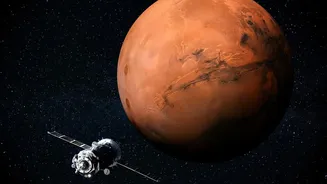
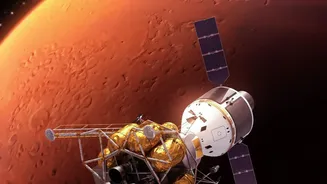
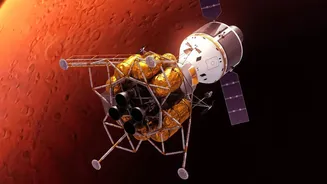
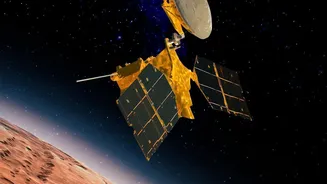
To crack the case, the Japan Aerospace Exploration Agency (JAXA) launched the Martian Moons eXploration (MMX) mission in October 2026. This ambitious project is the world's first attempt to land on Phobos, collect a sample, and return it to Earth. JAXA is not alone in this venture; it's a major international collaboration. NASA has provided key scientific instruments, including a gamma-ray and neutron spectrometer to determine the moon's composition and a pneumatic sampler to collect surface material. The German and French space agencies (DLR and CNES) built a small rover named 'Idefix', and the European Space Agency (ESA) is providing communications support. This global team is pooling its resources to tackle one of the solar system's 'most important unclimbed mountains', as one project manager described it.
The Ultimate Cosmic Heist
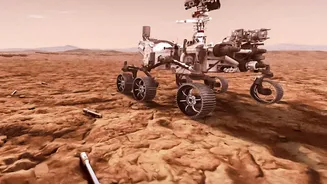
Collecting a sample from Phobos is an immense technical challenge. After arriving in the Mars system in 2027, the MMX spacecraft will spend years observing both moons. In 2029, it will deploy the Idefix rover from a height of about 40-100 metres. Due to Phobos’s extremely weak gravity, the rover will essentially drop and bounce before righting itself to explore the surface. Its job is to scout a safe and interesting landing zone for the main spacecraft. In 2030, the MMX mothership itself will descend for one or two landings, aiming to collect at least 10 grams of regolith (soil and rock) using two different systems: a corer for subsurface material and a gas-powered pneumatic sampler for surface dust. The entire landing and collection process must be completed in just a few hours.
The Long Journey Home
Once the precious sample is secured in a special return capsule, the spacecraft will depart the Martian system for its year-long journey back to Earth. In 2031, the capsule will detach, re-enter the atmosphere, and land in Australia, where a recovery team will be waiting. The samples will then be transported to a dedicated curation facility in Japan for analysis by a global team of scientists. Building on the success of its Hayabusa missions, which returned samples from asteroids, JAXA is leveraging its world-leading expertise in this type of complex sample-return operation.
What the Samples Could Reveal
Those 10 grams of dust could rewrite our understanding of the solar system. If the sample's composition resembles carbon-rich asteroids, it will support the 'captured asteroid' theory. If it's made of volcanic rock similar to Mars, it will point to a giant impact. But there's another tantalising possibility. Over billions of years, asteroid impacts on Mars have likely flung Martian soil into space, and some of it may have landed on Phobos. Scientists estimate that up to 0.1% of the sample could actually be ancient Martian material, offering a 'free' sample of the Red Planet without the difficulty of landing there. This material could even hold clues about whether Mars was once habitable.