


A Tale of Two Galaxies
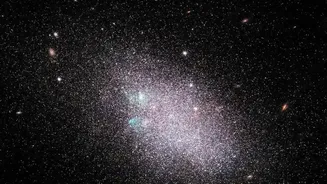
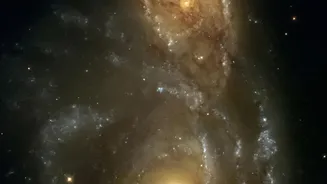
The story begins about 10 billion years ago, long before our solar system existed. At that time, a smaller, or 'dwarf', galaxy plunged directly into the heart of a young Milky Way. Astronomers have nicknamed this cosmic interloper the 'Gaia Sausage' or 'Gaia-Sausage-Enceladus'.
The name comes from data gathered by the European Space Agency's Gaia mission, which revealed that stars from this doomed galaxy now travel in elongated, sausage-shaped orbits within the Milky Way. The collision was the most significant merger in our galaxy's history, a violent event that tore the smaller galaxy to shreds and saw its stars absorbed into our own.
The Cosmic Crime Scene
Scientists pieced this story together by solving a long-standing galactic mystery: the behaviour of our stellar halo. This halo is a vast, sparse sphere of ancient stars surrounding the main galactic disc. Observations showed that while stars in the disc orbit the galactic centre at a brisk 220 kilometres per second, stars in the halo move much more slowly, at only about 25 kilometres per second. To understand why, researchers at Durham University ran powerful supercomputer simulations. Their models showed that when a Milky Way-like galaxy suffers a massive, head-on collision, the aftermath can cause the entire galactic disc to gradually flip over, reorienting by more than 90 degrees over hundreds of millions of years. This 'disc flip' perfectly explained the slow-moving halo stars seen in our own galaxy, providing a smoking gun for the ancient crash.
What 'Knocked Sideways' Really Means
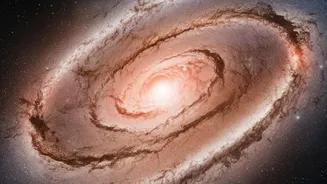
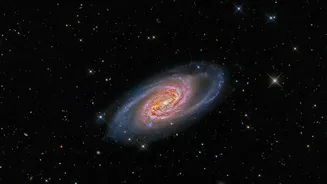
The term 'knocked sideways' refers to this dramatic change in orientation. Imagine the Milky Way as a spinning frisbee. The collision didn't just rattle it; it exerted a powerful gravitational torque that caused the entire frisbee to slowly tilt and flip over within its larger, invisible halo of dark matter. This explains not only the slow halo but also the peculiar shape of the Milky Way today. We know our galaxy's disc isn't perfectly flat; it has a distinct warp, with one side curving up and the other down. This warped and flared shape is a direct consequence of the gravitational disruption caused by this ancient cosmic punch.
An Ever-Evolving Home
The Gaia Sausage collision was the last truly massive merger in our galaxy's past, but the Milky Way’s story of galactic cannibalism is far from over. It is currently in the process of absorbing another, much smaller satellite galaxy known as the Sagittarius Dwarf Galaxy. This ongoing interaction is also leaving its mark, causing ripples and warps in our galaxy's disc, and may have even triggered bursts of star formation, possibly including the one that formed our own Sun. However, because the Sagittarius galaxy is far less massive than the Gaia Sausage was, its impact on the Milky Way's overall structure will be much less dramatic.