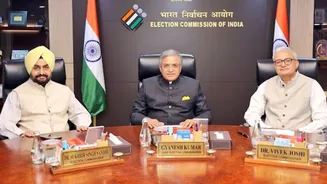







The Election Commission of India has reiterated a fundamental rule of our democracy: only elected legislators can vote for the President. This isn't a new change, but a crucial clarification that highlights the unique nature of how India chooses its head
of state.
Who Exactly Votes for the President?
The President of India is elected indirectly, not by a popular vote of all citizens, but by a select group known as the electoral college. As laid out in Article 54 of the Constitution, this body is composed exclusively of elected representatives. Specifically, it includes the elected Members of Parliament from both the Lok Sabha and the Rajya Sabha. It also comprises the elected Members of the Legislative Assemblies (MLAs) of all states. Furthermore, following a constitutional amendment, the elected MLAs from the Union Territories of Delhi and Puducherry are also part of this electoral college, ensuring representation from these legislatures as well.
The Key Distinction: Elected vs. Nominated
The word 'elected' is the most important qualifier here. The electoral college for the presidential election pointedly excludes any member who is nominated to their position. This means the 12 members nominated to the Rajya Sabha by the President for their contributions to art, literature, science, and social service cannot vote. Similarly, any nominated members in state legislative assemblies are also ineligible to participate in the presidential poll. This rule is strict and central to the process. It's a clear line drawn to define who gets a say in choosing the nation's first citizen.
Why Are Nominated Members Excluded?
The reasoning behind this exclusion is rooted in a core democratic principle and simple logic. The President is the head of the Republic, representing the will of the people as expressed through their elected representatives. Nominated members, while often distinguished individuals, are not chosen by popular vote and do not carry a direct mandate from the public. Their inclusion would dilute the principle of indirect election by the people. There is also a more direct conflict of interest to consider: since some members of the Rajya Sabha are nominated by the President, allowing them to vote could mean a President has a hand in choosing their own electors, a situation the framers of the Constitution sought to avoid.
What About Legislative Councils?
Another group of legislators left out are the Members of Legislative Councils (MLCs) in states that have a bicameral legislature. Not all states have a Legislative Council, and their members are elected through a mix of methods, not all of which are direct popular votes. To maintain uniformity and equal footing among the states, only the directly elected members of the lower house—the Legislative Assembly—are included. This ensures that states with a second chamber do not get a disproportionately larger say in the presidential election compared to states that only have a legislative assembly.
The Role of the Election Commission
The Election Commission of India is the constitutional authority responsible for the superintendence, direction, and control of the presidential election. Its role is to ensure the election is conducted freely and fairly according to the rules laid down in the Constitution and relevant acts like The Presidential and Vice-Presidential Elections Act, 1952. By issuing clarifications, the ECI reinforces these foundational rules, removes any ambiguity, and ensures all stakeholders are aware of the precise composition of the electoral college. The process is conducted by secret ballot, and party whips do not apply, allowing legislators to vote according to their conscience.