





Not Just Giant Space Rocks
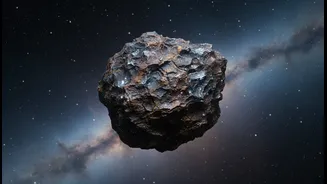
When we picture an asteroid, we might imagine a single, solid piece of rock hurtling through space. While some are like that, many of the asteroids that scientists are most interested in are what they call 'rubble piles'. These are not monolithic boulders
but loose collections of rocks, dust, and debris that have come together under their own weak gravity. Think of them less like a solid cannonball and more like a giant, floating bag of gravel. Spacecraft missions to asteroids like Bennu, Ryugu, and Dimorphos have shown that these rubble pile structures are surprisingly common, especially for asteroids under 10 kilometers in diameter. They are often formed from the debris of ancient, larger bodies that were shattered by collisions. This structure gives them a low density and can make them surprisingly resilient, with their loose composition acting like a shock absorber against impacts.
The Science of the Wobble
So, how can you peek inside an object millions of kilometers away? One proposed method involves closely observing its rotation. Just like a spinning top on a table, a rotating asteroid can exhibit complex motions. The two key movements are precession and nutation. Precession is a steady, slow change in the orientation of the rotation axis, like how a top's axis draws a circle as it spins. Nutation is a smaller, periodic 'nodding' or 'wobbling' motion on top of that precession. For a perfectly rigid, solid object, these motions are predictable. But for a non-rigid object like a rubble pile, the story changes. The way it wobbles depends on how its internal components can shift and rub against each other, a process that dissipates energy through internal friction. Observing this subtle wobble can therefore provide clues about the asteroid's inner workings. Recent observations of the asteroid Donaldjohanson by the Lucy spacecraft revealed just such a complex, wobbling rotation, hinting at its history and structure.
A Cosmic Diagnostic Tool
By precisely measuring an asteroid's wobble, scientists believe they can infer how tightly its constituent parts are held together. An asteroid that is more 'fluid' or loosely packed will wobble differently than one whose pieces are more compacted or have greater friction between them. A more rigid internal structure would dampen these wobbles more quickly, while a looser collection of rubble would allow for more complex tumbling. This technique essentially allows researchers to perform a remote diagnostic test, turning the asteroid's natural motion into a probe of its interior. It’s a way of understanding properties like cohesion and internal friction without having to land on the surface and drill—a complex and expensive task. The planning of future missions can incorporate periods of careful observation specifically designed to capture these rotational dynamics, providing a wealth of data before any attempt is made to interact with the asteroid directly.
Why It Matters for Planetary Defense
Understanding an asteroid's internal structure isn't just an academic exercise; it's critical for planetary defense. If we ever need to deflect an asteroid on a collision course with Earth, knowing what it's made of is paramount. NASA's successful DART mission in 2022 showed that a kinetic impactor—a spacecraft designed to crash into an asteroid—can successfully alter its trajectory. However, the effectiveness of such a mission depends heavily on the target's composition. Hitting a solid rock is very different from hitting a loose pile of rubble. An impact on a rubble pile might just disperse some of the material or be absorbed with less change in momentum, almost like punching a beanbag. A study of the DART impact estimated that the debris blasted from the asteroid Dimorphos roughly doubled the effective force of the impact, highlighting how crucial the asteroid's response is. Knowing whether an asteroid is a solid body or a loose collection of pieces will help scientists design the most effective deflection strategy, whether it's a kinetic impactor or another proposed method.