






A New Visitor in Our Cosmic Neighborhood
In recent days, astronomers operating sky-survey telescopes detected a faint point of light moving against the backdrop of distant stars. Designated C/2026 U5, the object was quickly flagged as a 'candidate' near-Earth object (NEO), prompting a global
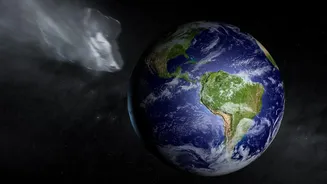
network of observers to turn their attention towards it. Initial calculations are always fraught with uncertainty, and it's this early period that requires the most scrutiny. An NEO is any small Solar System body, like an asteroid or comet, whose orbit brings it within 1.3 astronomical units of the Sun. This latest object is estimated to be approximately 150 meters in diameter, large enough to cause significant regional damage if it were to impact Earth, placing it firmly in the category of a 'Potentially Hazardous Asteroid' (PHA) that warrants careful monitoring.
How Astronomers Track and Assess Risk
Discovering a new NEO is just the first step. The real work begins with tracking its movement to plot its orbital path with precision. Observatories around the world coordinate through organizations like the Minor Planet Center and NASA's Planetary Defense Coordination Office (PDCO). They take multiple images over hours and days to refine the object’s trajectory. When an object like C/2026 U5 is first found, its orbital arc is very short, leading to a wide range of possible future paths. Some of these initial projections might intersect with Earth's orbit, leading to a non-zero impact probability. It can take a week or more of continuous observations to shrink these uncertainties. Scientists use tools like the Torino Scale, a 0-to-10 rating system, to communicate the level of risk to the public. A rating of 0 means essentially no chance of collision, while a 1 indicates a discovery that merits more observation but is no cause for public concern.
From Potential Concern to Scientific Curiosity
After several days of intense observation from multiple telescopes, astronomers successfully gathered enough data to map the full orbit of C/2026 U5. The verdict is clear and reassuring: it will not hit Earth. The refined calculations show that the object will make its closest approach in early 2027, passing our planet at a comfortable distance of over 5 million kilometers—more than 13 times the distance to the Moon. With the impact risk officially ruled out, the focus shifts from planetary defense to scientific inquiry. Even harmless flybys provide invaluable opportunities for study. The object's path, composition, and rotation can offer clues about the formation of our solar system. Every new asteroid or comet is a time capsule from billions of years ago, carrying pristine material from the dawn of the planets.
The Bigger Picture of Planetary Defense
The successful identification and tracking of C/2026 U5 is a testament to the effectiveness of our global planetary defense systems. Programs supported by NASA and other space agencies have been tasked with finding 90 percent of NEOs larger than 140 meters. These surveys continuously scan the skies, discovering thousands of objects each year. This proactive approach ensures that if a genuine threat were to emerge, we would likely have years, if not decades, of warning. This lead time is crucial. Missions like NASA's Double Asteroid Redirection Test (DART) have already proven that we have the technology to alter an asteroid's trajectory. In 2022, the DART spacecraft successfully slammed into the asteroid Dimorphos, changing its orbit by a greater degree than scientists expected and marking a major milestone for planetary defense.