







Meet the Universe's 'Shadow Blasters'
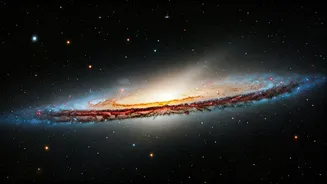
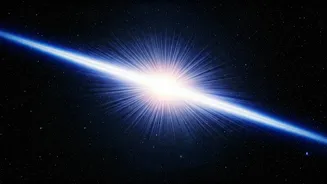
The headline's 'Shadow Blaster' is a creative name for a real and astonishing cosmic object known as a blazar. A blazar is a galaxy with a supermassive black hole at its center that is actively feeding on surrounding gas, dust, and even stars. Not all
of this material falls into the black hole; some is channeled into two powerful jets of ionized matter that shoot out in opposite directions at nearly the speed of light. What makes a blazar special is that one of these jets happens to be pointed almost directly at Earth, making it appear exceptionally bright and energetic to our telescopes. This unique orientation gives us a front-row seat to one of the most powerful phenomena in the universe.
Uncovering a Hidden Engine
The 'hidden region' refers to a recent scientific breakthrough that challenges previous understandings of how these jets work. For a long time, scientists have been puzzled because the jets they could observe often seemed too slow or not dense enough to create the ultra-high-energy particles detected on Earth. However, new, highly detailed radio observations of a blazar named TXS 0506+056 have revealed a complex, layered structure. Researchers found evidence of a very fast, narrow 'spine' of plasma hidden inside a slower, wider 'sheath'. This inner spine, which was previously masked by the brighter outer layers, moves much faster and is the perfect environment for extreme particle acceleration.
A Cosmic Particle Accelerator
So, how does this hidden spine generate such powerful particles? It acts as a natural particle accelerator, far more powerful than anything built on Earth, like the Large Hadron Collider at CERN. Within the jet, intense magnetic fields and shockwaves work together to propel particles like protons to incredible speeds. The discovery of the fast inner spine provides the missing piece of the puzzle: it's a region where the conditions are extreme enough to accelerate particles to the energies required to produce cosmic rays and high-energy neutrinos. These particles carry so much energy that a single one can have the same kinetic energy as a tennis ball served at over 90 kilometres per hour.
The Hunt for Cosmic Ray Origins
This discovery is a huge step forward in solving one of high-energy astrophysics' biggest mysteries: the origin of ultra-high-energy cosmic rays (UHECRs). These are the most energetic particles ever detected, raining down on Earth from space, but their sources have remained elusive. Because they are charged particles, their paths are bent by magnetic fields as they travel across the universe, making it impossible to simply trace them back to their origin. High-energy neutrinos, however, are uncharged and travel in straight lines. By linking a high-energy neutrino event back to the blazar TXS 0506+056, and now understanding the jet structure that can create it, scientists have found a concrete, testable model for at least one source of these extreme cosmic messengers.
Why This Discovery Matters
Confirming that blazars, with their newly discovered hidden structures, are indeed cosmic accelerators has profound implications. It provides a physical explanation for how nature generates particles with energies millions of times greater than human-made accelerators. This research, often involving global collaborations and sophisticated observatories from space-based telescopes to detectors buried under Antarctic ice, helps us understand the most extreme physics in the universe. Each discovery like this refines our models of how galaxies evolve, the role supermassive black holes play, and the fundamental laws that govern the cosmos.