







A New Hub for Rocket Innovation
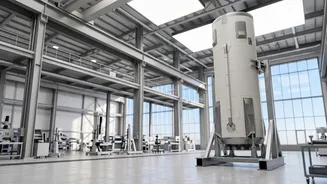
Agnikul Cosmos recently inaugurated two major additions to its Chennai campus: the Stage Testing & Inspection Facility (STIF) and the Pressurant Tank Realisation, Over-wrapping and Outfitting Facility (PROOF). These are not just generic workshops; they
are highly specialized centers designed to give Agnikul end-to-end control over building and, crucially, testing rockets that can be flown more than once. The inauguration was attended by Group Captain Shubhanshu Shukla, one of India's Gaganyaan astronaut-designates, highlighting the national importance of this development. By bringing more of its manufacturing and testing in-house, Agnikul aims to accelerate production, improve quality control, and reduce its reliance on external suppliers.
The 'Holy Grail' of Reusability
For decades, rockets were single-use machines. The most expensive parts—the engines and avionics—would be discarded after just one flight, falling into the ocean as expensive debris. Reusable rockets change this equation entirely. The goal is to recover the most valuable parts of the launch vehicle, primarily the first stage, and fly them again. This dramatically lowers the cost of accessing space, much like how an airplane is reused for thousands of flights. By pursuing reusability, Agnikul is joining an elite group of global companies aiming to make space launches more frequent and affordable. This move is critical for India's ambition to capture a larger share of the commercial satellite launch market.
What Does 'Re-qualify' Really Mean?
The key detail in Agnikul's announcement is the ability to 're-qualify' rocket stages. In aerospace, 'qualification' is the rigorous process of proving that a component meets all design and safety requirements to fly. 'Re-qualification' applies this process to a recovered, or used, stage. After a rocket stage is brought back from a mission, it must be thoroughly inspected for any damage or stress from the flight. The STIF facility is designed for precisely this. It can conduct full-stage tests under conditions that mimic an actual mission, including long-duration engine burns and cryogenic temperatures. Engineers can then analyze the data to certify that the stage is fit for another launch. This build-test-fly-recover-inspect-and-fly-again cycle is the core of making reusability a reality.
Building on Agnibaan's Success
This expansion doesn't come out of nowhere. It builds on the momentum from Agnikul's successful launch of Agnibaan SOrTeD (Suborbital Tech Demonstrator) in May 2024. That mission was a landmark achievement, validating the company's proprietary 3D-printed, single-piece engine and its in-house avionics and control systems. The Agnibaan rocket is designed to be highly customizable for the small satellite market. The new facilities will now support the development of the full orbital version of Agnibaan and its future reusable variants. The company's next major step, Mission-02, is expected to be its first attempt at recovering an orbital-class booster.
The Bigger Picture for India's Space Economy
Agnikul's new infrastructure is a significant milestone for India's entire space ecosystem. It signals a shift from relying solely on the venerable ISRO to fostering a dynamic private sector capable of innovating and competing on a global scale. With these facilities, Agnikul becomes the only private Indian company with the in-house capability to inspect and requalify rocket stages after a flight. This vertical integration—controlling everything from component manufacturing with 3D printing to post-flight validation—is a powerful strategic advantage. It not only shortens development timelines but also builds a deep reservoir of expertise within the country, positioning India as a formidable player in the new global space race.