







Beyond the Static Hold
The standard plank is a titan of core exercises, celebrated for its ability to build abdominal strength and stability. But holding a static position only takes you so far. When you introduce movement by transitioning between a high plank (on your hands)
and a forearm plank, you create a dynamic challenge that significantly boosts the workout's intensity and effectiveness. This movement, often called an up-down plank, forces your muscles to work through a greater range of motion under tension, which is a powerful combination for building muscular endurance. It transforms the plank from a passive hold into an active, strength-building exercise that engages more than just your core.
Anatomy of the Movement
The magic of the plank transition lies in the sheer number of muscles it recruits simultaneously. While your core—including the transverse abdominis, rectus abdominis, and obliques—works overtime to keep your spine stable, your upper body gets a serious workout. Your deltoids (shoulders), pectorals (chest), and triceps are heavily engaged as you lower and push your body up. Furthermore, your back muscles, like the rhomboids and latissimus dorsi, activate to stabilize your shoulder blades, while your glutes and quads fire to keep your body in a straight line from head to heels. This makes it a highly efficient, full-body exercise.
Your Step-by-Step Guide
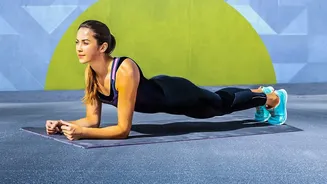
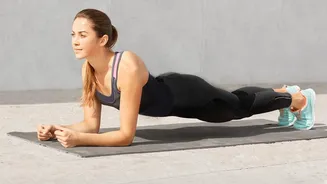
To perform the plank transition correctly and safely, focus on control over speed. Rushing the movement can lead to poor form and potential injury. Follow these steps for perfect execution: 1. Start in a high plank position, with your hands directly beneath your shoulders, arms straight, and body forming a straight line. Engage your core and glutes. 2. Lower one arm, placing your forearm on the floor with your elbow directly under your shoulder. 3. Follow with the other arm until you are in a standard forearm plank position. Keep your hips as still as possible. 4. To return to the start, place the hand of the arm that went down first back on the floor directly under your shoulder and push up. 5. Follow with the other hand to return to the high plank position. That completes one repetition. 6. Alternate which arm leads the movement down and up to ensure balanced muscle development.
Form Over Speed: Mistakes to Avoid
The most common mistake is allowing the hips to rock from side to side or sag toward the floor. This not only reduces the exercise's effectiveness but also puts unnecessary strain on your lower back. To prevent this, actively tighten your core and squeeze your glutes throughout the entire movement. Another pitfall is placing your hands too far in front of your shoulders or letting your elbows flare out too wide. This compromises stability and can stress your shoulder joints. Keep your gaze slightly ahead of your hands on the floor to maintain a neutral neck and spine alignment, avoiding the urge to drop your head or look up.
Integrating Into Your Workout
How you add plank transitions to your routine depends on your fitness level. For beginners, starting with a modified version on your knees can help you master the form without overloading your muscles. You could aim for 2-3 sets of 8-12 repetitions, focusing on slow, controlled movements. As you get stronger, you can progress to your toes. Intermediate and advanced individuals can incorporate plank transitions as a challenging finisher to their workout or as part of a core-focused circuit. Try performing 3-4 sets of as many repetitions as possible with good form, or work for timed intervals, such as 45 seconds of work followed by 15 seconds of rest.