
Our Familiar Magnetic Shield
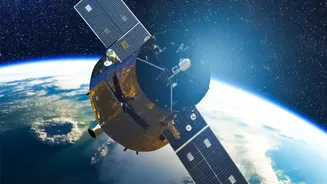
Every planet with a magnetic field has a magnetosphere, a vast region where its own magnetic influence overpowers the constant stream of charged particles from the Sun, known as the solar wind. On Earth, this field is generated by the churning of our
liquid iron core. It acts like an invisible shield, deflecting harmful solar radiation. This interaction creates phenomena like the Van Allen radiation belts and the beautiful northern and southern lights. A key feature of Earth's magnetic field is that its axis is tilted by about 11 degrees relative to the planet's spin axis. This tilt is believed to be essential for sustaining the internal dynamo that generates the field itself. For decades, scientists assumed other planets would follow similar, if not identical, rules.
Saturn’s Perfectly Aligned Problem
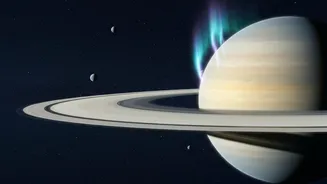
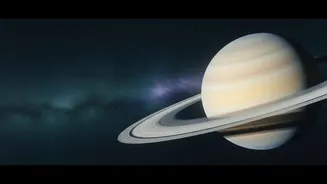
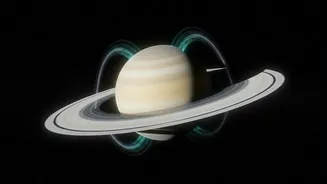
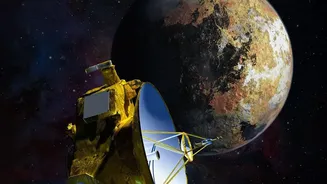
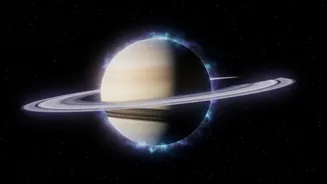
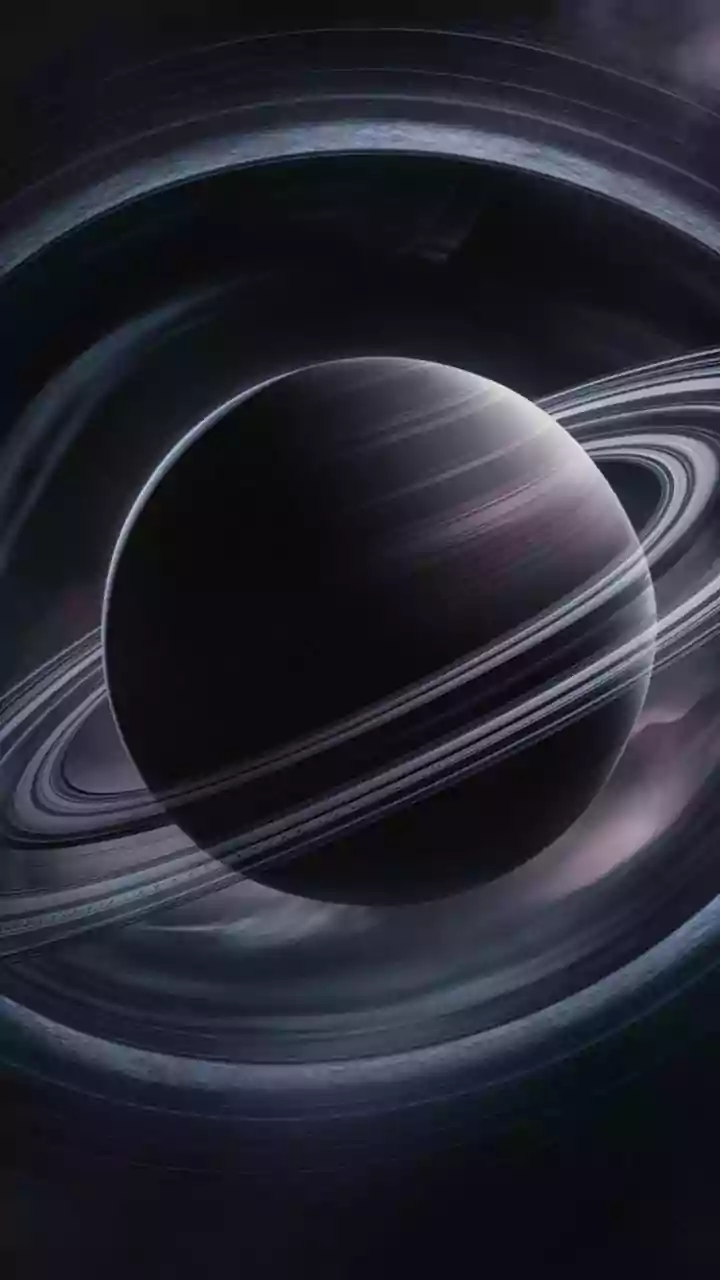
Data from NASA's Cassini spacecraft, which orbited Saturn from 2004 to 2017, has shown that the ringed planet breaks this rule spectacularly. One of the most perplexing discoveries is that Saturn's magnetic axis is almost perfectly aligned with its rotational axis, with a tilt of less than one degree. According to existing theories of how planetary dynamos work, a field this perfectly aligned shouldn't be sustainable; without a significant tilt, the internal currents generating the field should eventually die down, causing the magnetosphere to vanish. Yet Saturn has the second-largest magnetosphere in the solar system, bested only by Jupiter. This fundamental mystery has forced scientists to rethink the very physics of how planetary magnetic fields are born and sustained.
A Shield Shaped by Spin and Moons
Recent analysis has revealed another major difference: Saturn's magnetosphere is lopsided and dominated by the planet's own rapid rotation, not the solar wind. Earth's magnetosphere is largely shaped by the pressure of the solar wind, creating a weak point, or cusp, around noon local time where solar particles can funnel in. But Saturn spins much faster, with a day lasting only 10.7 hours. This rapid spin, combined with a thick soup of plasma spewed out by its moons, drags the entire magnetic structure around. New findings show that Saturn's cusp is skewed far into its afternoon side, a direct result of its internal dynamics overpowering the Sun's influence. This confirms that for gas giants, the planet's own properties are the primary driver shaping its space environment.
The Enceladus Effect
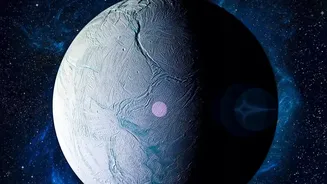
You can't talk about Saturn's magnetosphere without mentioning its moon, Enceladus. This small, icy world is a huge source of material for the magnetic bubble. Geysers erupting from Enceladus's south pole continuously blast up to 1,000 kg of water vapor per second into space. This material becomes ionized (electrically charged) and is captured by Saturn's magnetic field, forming a vast plasma torus that co-rotates with the planet. This constant supply of heavy plasma from Enceladus and other moons 'loads down' the magnetosphere, slowing its rotation and contributing to its unique, asymmetrical shape. In effect, Saturn's rings and moons act as both a source and a sink, supplying plasma while also absorbing charged particles, carving out empty regions within the magnetic field that are unseen at Earth.
Why Saturn's Weirdness Matters
Studying Saturn's strange magnetic shield does more than satisfy our curiosity. It provides a crucial, alternative model for how magnetospheres can work. The fact that Saturn sustains a massive, symmetrical field without a significant tilt challenges our core understanding of planetary science. Furthermore, understanding how its fast rotation and active moons create such a unique environment helps scientists model the magnetospheres of exoplanets orbiting other stars. Discoveries about processes like magnetic reconnection—where magnetic field lines break and reconnect, releasing huge amounts of energy—show that these events happen differently at Saturn compared to Earth, providing a new natural laboratory for studying plasma physics. These findings highlight just how diverse planets can be, even within our own solar system.