

A Galaxy Winding Down
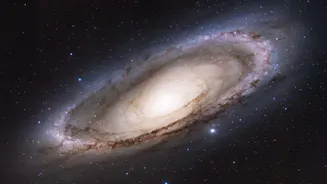
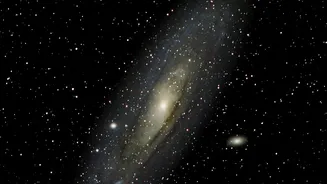
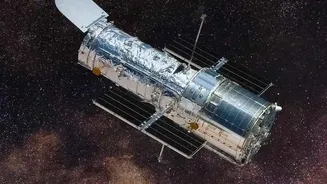
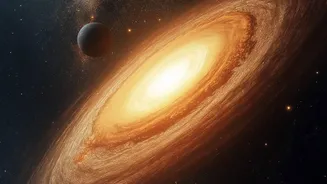
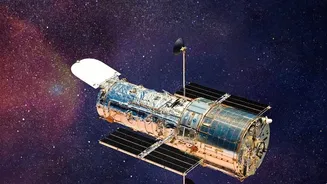
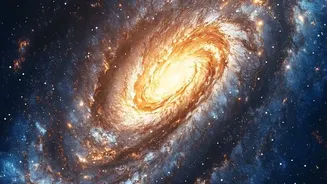
Our closest large galactic neighbor, the Andromeda galaxy, is slowly dimming its stellar nurseries. A recent study using extensive data from NASA's Hubble Space Telescope reveals that the rate of star formation in Andromeda has been steadily declining
for the last 500 million years. More strikingly, this slowdown has become even more pronounced in the last 40 million years. Once a bustling hub of creation, Andromeda's output of new stars has plummeted. To put it in perspective, 500 million years ago, the galaxy was churning out new stars equivalent to about one of our suns each year. Today, that rate has dropped to just one-fifth of a solar mass annually. This finding suggests Andromeda is transitioning from an active, star-forming galaxy into a more settled, or 'quiescent,' state.
The Fossil Record in the Stars
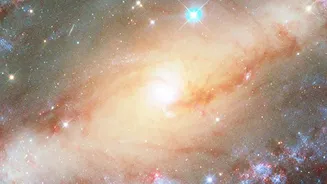
To uncover this cosmic history, astronomers didn't use a time machine; they used the stars themselves as a 'fossil record'. An international team of researchers analyzed data from two massive Hubble surveys, meticulously mapping about two-thirds of Andromeda's sprawling disk. This allowed them to measure the properties of nearly 200 million individual stars. The method relies on a simple principle: massive stars burn hot, blue, and fast, living short lives, while smaller, less massive stars glow redder and live much longer. By analyzing the color and distribution of stars in different regions, scientists can determine when and where star birth was most active. Areas rich in blue stars point to recent activity, while a dominance of redder stars indicates an older, more settled population.
What is a 'Quiescent' Phase?
In astronomy, a galaxy entering a 'quiescent' phase is one where the process of star formation has significantly slowed down or stopped altogether. These galaxies aren't dead, but their most energetic, creative period is behind them. They are typically filled with older, redder stars and lack the vibrant, blue-hued nurseries of gas and dust that characterize younger, more active galaxies. The study found that Andromeda isn't necessarily running out of the raw material—gas and dust—needed to make new stars. Instead, the decline appears to be a natural part of its evolution, like an athlete taking a breather after a long period of exertion. This winding-down follows a massive burst of star formation that occurred around 2 billion years ago, likely triggered by a past collision with a smaller galaxy.
A Glimpse into Our Own Future
Studying Andromeda is like looking in a cosmic mirror that shows a possible future for our own Milky Way galaxy. As a fellow large spiral galaxy, the Milky Way is expected to follow a similar evolutionary path. Understanding Andromeda's transition helps astronomers refine their models of how galaxies form, age, and eventually quiet down. While our own galaxy is still actively forming stars, Andromeda’s present state gives us a preview of what might lie ahead for us in the cosmically distant future. The stars, once furiously igniting, are now settling into a long, quiet twilight. This knowledge provides a crucial piece of the puzzle in understanding the grand life cycles of galaxies across the universe.
The Coming Collision
Andromeda's current slowdown is just one chapter in its long story. The next major event on its cosmic calendar is a monumental collision with our own Milky Way. The two galaxies are hurtling toward each other at about 110 kilometers per second, drawn together by their mutual gravity. In about 4.5 billion years, they are predicted to begin a galactic merger that will unfold over billions of years. This spectacular event will temporarily reverse Andromeda's quietude, triggering a massive new burst of star formation as the vast clouds of gas and dust from both galaxies slam into each other. Ultimately, the two spirals will likely merge into a single, giant elliptical galaxy, eventually nicknamed 'Milkomeda'.