




From Ingenuity to a Helicopter Trio
The incredible success of NASA’s Ingenuity helicopter proved that powered flight is possible in the thin Martian atmosphere. It completed 72 flights, acting as an invaluable aerial scout for the Perseverance rover. Now, NASA is ready for the next step
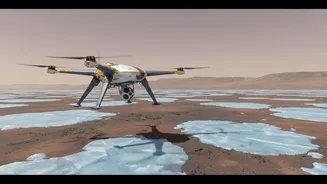
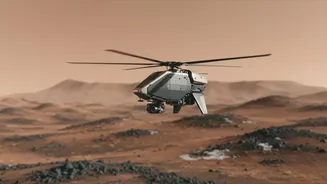
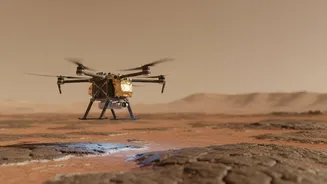
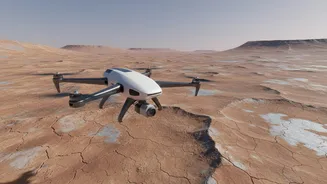
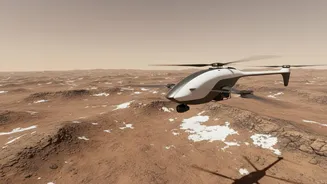
with the Skyfall mission. Instead of one small helicopter, Skyfall will send a trio of more advanced rotorcraft to the Red Planet. Building on Ingenuity’s design, these new helicopters will be equipped with a suite of scientific instruments, designed not just to scout, but to conduct significant scientific investigations on their own. This marks a shift from a technology demonstration to a full-fledged aerial science mission, managed by NASA's Jet Propulsion Laboratory (JPL) and co-designed with AeroVironment, the same company that helped build Ingenuity.
What is Ground-Penetrating Radar?
Ground-penetrating radar, or GPR, is a technology that allows scientists to see what’s hidden underground without ever digging. It works by sending radio waves into the ground. When these waves hit different materials or layers—like rock, sand, or ice—they bounce back to a receiver. The time it takes for the signals to return and their strength reveals the structure and composition of the subsurface. GPR is already being used on Mars by the Perseverance rover's RIMFAX instrument, which can create 2D cross-sections of the ground as the rover drives. It gives us a glimpse of buried rock layers and other geological features, but its reach is limited by where the rover can physically travel.
A 'Cape' for Seeing Underground
The key innovation for Skyfall is mounting a GPR system on a helicopter. This presents a unique engineering challenge: the antenna needs to be lightweight and durable. The solution developed by JPL is a flexible, fabric-based antenna that hangs below the helicopter like a small cape. Made of strong materials like polyester and Vectran, this antenna is designed to bend and flex when the helicopter lands and then spring back into its correct shape for collecting data in the air. This 'cape' allows the helicopter to fly low and slow, capturing high-resolution images of the ground just beneath the surface—a zone that orbiting spacecraft can't see in detail.
The Search for Shallow Ice
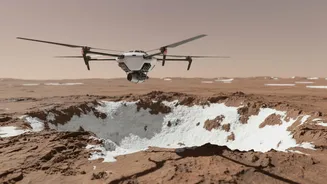
The primary goal for Skyfall's GPR is to find water ice hidden just a few feet below the surface. Orbiters have found evidence of massive ice deposits deep underground, but locating shallow ice is critical for future human exploration. Astronauts on Mars would need accessible water not just for drinking, but also to produce breathable oxygen and rocket fuel. By flying over vast and rugged terrains that are inaccessible to rovers, the Skyfall helicopters can create detailed maps of these shallow ice deposits. According to Adrian Tang, a lead scientist on the project, flying close to the ground is the only way to remotely detect this shallow ice and understand its extent.
An Ambitious Mission Profile
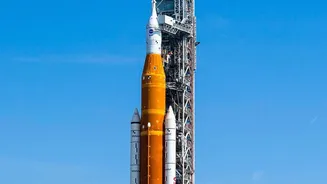
The Skyfall mission concept is bold from the very beginning. Instead of a complex landing system, the plan involves a daring mid-air deployment. A descent stage will slow down in the Martian atmosphere, at which point the three helicopters will fly off on their own and land individually. This maneuver reduces the cost and complexity associated with traditional landers. The mission is currently planned for a potential launch in late 2028 aboard NASA's Space Reactor-1 Freedom, the first nuclear fission-powered interplanetary spacecraft. Once on Mars, the helicopters will operate independently, transmitting their data directly to orbiting spacecraft, unlike Ingenuity which had to rely on the Perseverance rover as a communications relay.