






The quest for better coordination is a common goal in fitness. Both jumping rope and running are popular cardio choices, but they train your body's rhythm and coordination in surprisingly different ways. Let's break down how each one works.
The Rhythmic Precision of Jumping Rope
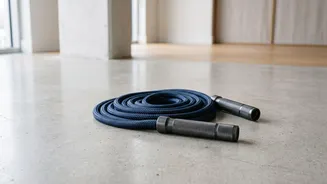
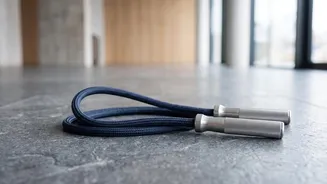
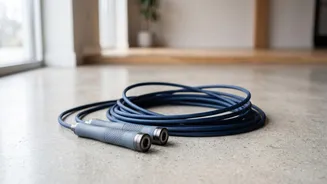
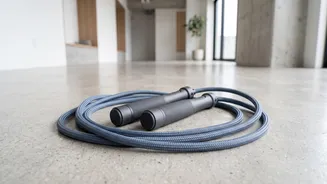
Jumping rope
is a masterclass in timing and rhythm. It demands a high-speed conversation between your brain, hands, and feet. To successfully clear the rope, your body must create and sustain a perfect, cyclical rhythm. Every turn of the wrist must synchronize with the jump, creating a constant feedback loop. If your timing is off even by a fraction of a second, the rope catches your feet, providing immediate, corrective feedback. This process rapidly enhances hand-eye-foot coordination, forcing your neuromuscular system to learn a new, precise motor pattern. It's a full-body effort where the arms and wrists control the rope's tempo while the legs and feet react, all while the core remains engaged to stabilize the body. This makes it an incredibly efficient way to develop agility and control over your body's movements.
Running and the Rhythm of Endurance
Running, on the other hand, develops a different kind of rhythmic coordination. For most people, running is a more innate movement pattern, not a skill to be learned from scratch like jumping rope. The coordination in running is less about rapid, conscious timing and more about maintaining an efficient, sustainable rhythm over a longer duration. This is often referred to as gait or running rhythm, which involves the harmonious interplay of your arm swing, breathing, cadence (steps per minute), and stride. Efficient runners often find a 'flow state' where their movements are smooth and connected, which helps conserve energy and reduce the risk of injury. The coordination here is about creating a stable, repeatable motion that propels you forward with minimal wasted effort, adapting to changes in pace or terrain while maintaining balance.
How Each Activity Trains the Brain
From a neurological perspective, the two activities offer distinct benefits. Jumping rope is a cognitive challenge. Learning new motor patterns improves communication between your brain, wrists, and lower leg muscles, which has been shown to enhance overall cognitive function. It forces your brain to remain highly engaged, building new neural pathways for complex, multi-limb coordination. Running's rhythm is governed more by what are known as central pattern generators in the spinal cord—neural circuits that control repetitive tasks like walking and running, often subconsciously. While running certainly requires coordination, especially on uneven trails, the base rhythm is more automatic. The coordination challenge in running is often about fine-tuning this existing pattern for efficiency and endurance, rather than learning a new one.
Transferable Skills for Sports and Life
The coordination gained from each activity has different applications. The quick, light-footed agility from jumping rope is highly beneficial for sports that require fast changes in direction, like boxing, tennis, and basketball. It builds explosive power in the calves and improves the stability of the ankle and knee joints, which can help reduce the risk of injury in other sports. The coordination developed through running is more fundamental to overall athleticism. It builds a base of cardiovascular endurance and a strong, stable gait that is foundational for nearly all field and endurance sports. A smooth, efficient running form allows an athlete to conserve energy that can then be used for sport_specific skills.
Which Is Right for Your Goals?
There's no clear winner; the 'better' exercise depends entirely on what you want to achieve. If your primary goal is to improve quickness, agility, timing, and full_body coordination in a time_efficient workout, jumping rope is an outstanding choice. It’s a high_intensity workout that burns a significant number of calories in a short amount of time. If your goal is to build long_distance endurance, improve your foundational cardiovascular base, or you simply enjoy the meditative rhythm of a long run , then running is your best bet . Many athletes find that the two activities complement each other perfectly . Runners can use jump rope to warm up or as a cross_training tool to improve their foot speed and running economy , while jumpers can use running to build their aerobic base for longer , more intense sessions . Ultimately , the best rhythm for you is the one that keeps you moving consistently toward your fitness goals .