



The Solar System’s Volcanic Inferno
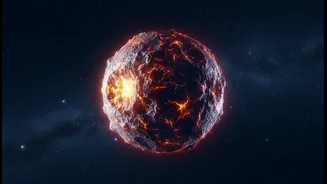
Imagine a world constantly tearing itself apart from the inside out. That’s Io. Caught in a gravitational tug-of-war with the gas giant Jupiter and its other large moons, Io is relentlessly squeezed and stretched. This process, known as tidal heating,
generates immense frictional heat deep within the moon's interior, melting rock into magma. The result is a hellish landscape pockmarked by hundreds of volcanoes, vast lava flows, and towering plumes of sulfurous gas that shoot hundreds of kilometers into space. Unlike Earth’s Moon, which is geologically quiet, Io is a world of perpetual, violent renewal. But while scientists understood the general principle of tidal heating, the specific mechanics—the plumbing of this volcanic inferno—remained largely hidden.
A Look Beneath the Crust
For years, our view of Io's volcanism was literally superficial. Missions like Voyager and Galileo captured stunning images of surface eruptions, and infrared telescopes could measure the temperature of fresh lava flows. These observations led many scientists to theorize that a shallow, global ocean of magma might be sloshing just beneath the moon's crust, feeding volcanoes all over the surface. However, looking at the surface is like trying to understand a car’s engine by only looking at the heat coming from the exhaust pipe. To truly understand what drives the volcanism, scientists needed to see the heat before it reached the surface. They needed a way to peer through the rock and sulfur to map the engine itself, something no previous mission was equipped to do.
Juno's Microwave Vision
Enter NASA's Juno spacecraft. While its primary mission is to study Jupiter itself, a series of daringly close flybys in late 2023 and early 2024 brought it within 1,500 kilometers of Io’s tortured surface. Juno carries an instrument perfectly suited for the task: the Microwave Radiometer (MWR). Originally designed to probe deep beneath Jupiter's clouds, the MWR can detect thermal microwave radiation at various frequencies. While infrared instruments see surface heat, the MWR’s lower-frequency channels can penetrate Io’s crust, sensing the temperature several feet down. For the first time, scientists could take the temperature of Io’s shallow subsurface and create a map of its hidden heat.
Mapping the Hidden Engine
The data returned by the MWR was revelatory. The instrument revealed that almost everywhere it looked, the temperature rose dramatically just a few feet below the surface, a much steeper gradient than could be explained by sunlight alone. This was direct evidence of heat rising from the interior. More importantly, the MWR map showed massive, localized regions of intense subsurface heat. Some areas, like the one corresponding to a volcanic complex called Zal Montes Patera, were significantly warmer than their surroundings, revealing the thermal footprint of the magma systems feeding the volcanoes. Instead of a uniform global magma ocean, the findings suggest a more complex network of subsurface magma, finally allowing scientists to connect specific heat sources below to the volcanic activity we see on top.
New Insights on Loki Patera
Juno’s flybys also provided an unprecedented look at Loki Patera, one of the largest and most powerful lava lakes in the solar system. The new data from Juno's instruments confirmed that Loki Patera is a massive depression filled with cooling lava, but with a few surprises. Observations showed that some small islands within the lake have remained in the same spot for over 45 years, since they were first imaged by Voyager 1. This suggests they are anchored to the floor of the lava lake, challenging models that assumed a simple, churning pool of magma. By studying how the lake’s crust cools and overturns, scientists can better model the immense volume of magma required to sustain such a feature.
From a Volcanic Moon to Habitable Worlds
Understanding Io is about more than just one violent moon. The process of tidal heating is a fundamental force across the outer solar system. The same gravitational flexing that melts rock on Io is believed to maintain vast liquid water oceans beneath the icy shells of other moons, like Jupiter's Europa and Saturn's Enceladus. These subsurface oceans are considered among the most promising places to search for extraterrestrial life. By studying tidal heating in its most extreme form on Io, scientists can build and refine models that help them understand the potential for habitable environments on these other, more welcoming worlds. Juno's look inside Io's engine provides a crucial piece of the puzzle in the search for life beyond Earth.