



A Nation on the 'Ring of Fire'
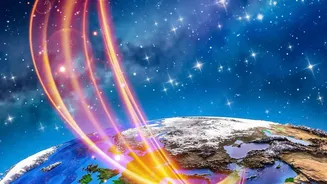
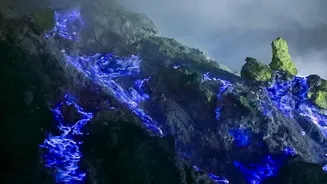
Japan’s turbulent geology stems from its location on the Pacific Ring of Fire, a vast, horseshoe-shaped belt that stretches for 40,000 kilometres around the Pacific Ocean. This is not a metaphor; it is the most geologically active region on Earth. About
90% of the world's earthquakes and more than 75% of its active and dormant volcanoes are located here. The Ring of Fire isn’t a single line but a complex network of boundaries where the gigantic tectonic plates that form Earth's crust meet, grind against each other, and plunge one beneath the other. Japan’s archipelago is situated in one of the most complex and active intersections of this entire system, making frequent tremors an unavoidable part of life.
The Great Tectonic Squeeze
The Japanese islands are caught in an incredible tectonic squeeze. They lie at the junction of four massive plates: the Pacific Plate to the east, the Philippine Sea Plate to the south, the Eurasian Plate to the west, and the North American Plate to the north. Imagine a multi-car pile-up happening over millions of years. The oceanic Pacific and Philippine Sea plates are heavier and denser, so as they push westward, they are forced to dive, or 'subduct', beneath the lighter continental plates that Japan sits on. The Pacific plate, for example, is sliding under northern Japan at a rate of about 8 to 9 centimetres per year—a blistering speed in geological terms. This constant movement ensures that stress is perpetually building up deep within the Earth's crust beneath the country.
How Stress Becomes a Quake
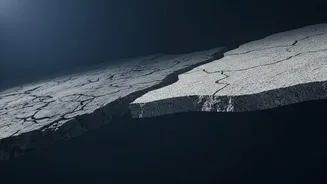
The process of subduction is not smooth. As one plate grinds its way underneath another, the edges can become locked together by friction. For years, decades, or even centuries, the plates remain stuck while the unstoppable motion behind them continues, causing the rock to bend and deform like a flexed ruler, storing up enormous amounts of energy. An earthquake occurs at the moment this built-up stress overcomes the friction. The locked section of the fault ruptures, and the plates suddenly snap past each other, releasing all that pent-up energy in seconds. This release sends out seismic waves in all directions, which we feel on the surface as violent shaking. The recent quake in Kumamoto was caused by this type of sudden rupture along a fault under stress.
From Shaking Ground to Ocean Waves
When a powerful earthquake happens offshore, particularly a 'megathrust' quake where a huge section of a subduction zone ruptures, the consequences can extend beyond the land. The sudden upward movement of the seafloor can displace a colossal volume of water, generating a series of powerful waves known as a tsunami. While the recent Kumamoto quake triggered a tsunami advisory that was later lifted, Japan’s history is marked by devastating tsunamis, most notably the one that followed the magnitude 9.0 Tōhoku earthquake in 2011. That event demonstrated how the same tectonic forces that cause the ground to tremble can also send the ocean surging inland with catastrophic power.
A Culture of Resilience
Living with this constant threat has forced Japan to become a world leader in earthquake preparedness and engineering. The country experiences around 1,500 quakes strong enough to be felt each year, a reality that has driven innovation and adaptation. Modern Japanese skyscrapers are not rigid; they are designed to sway. Many are built on massive base isolation systems with layers of rubber and steel that absorb seismic shocks, while others use advanced dampers, like giant pendulums, to counteract a building’s movement. This technical prowess is matched by societal readiness. Regular evacuation drills in schools and workplaces, readily available emergency kits, and a sophisticated nationwide early-warning system that sends alerts to mobile phones moments before strong shaking arrives, are all part of a deeply ingrained culture of preparedness.