






Beyond the Myth
Traditional Indian board games are often wrapped in layers of myth, with origins attributed to epic tales like the Mahabharata or ancient sages. While these legends highlight their deep cultural roots, firm historical evidence often points to a different,
though no less fascinating, timeline. Tracing the evolution of these games means separating verifiable facts from folklore. The oldest secure evidence for many games comes not from ancient religious texts, which may mention dice games without describing a specific board, but from archaeological finds, court chronicles, and tangible artifacts that show us how they were actually played.
Chaturanga: The Four-Limbed Army
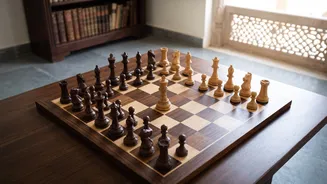
Chess is perhaps India's most famous cultural export in the world of games. Its ancestor, Chaturanga, is widely believed to have emerged during the Gupta Empire around the 6th century CE. The name itself, meaning 'four limbs' in Sanskrit, referred to the four divisions of the Indian army: infantry, cavalry, chariotry, and elephants. The game was played on an 8x8 board and served as a strategic tool to teach princes about warfare. Unlike modern chess, the pieces had slightly different movements. From India, Chaturanga travelled to Persia, where it became known as Shatranj, and the term for checkmate, 'Shah Mat' (the king is dead), was born. It later spread to Europe, evolving over centuries into the game we know today.
Pachisi: The Emperor's Game
Long before it was simplified into the modern game of Ludo, Pachisi was a game of skill and strategy enjoyed in royal courts. While some speculate about links to dice games in the Mahabharata or depictions in the Ellora Caves, the oldest verifiable evidence comes from the 16th century. The Mughal emperor Akbar was famously so fond of Pachisi that he had giant, life-sized courts built at Fatehpur Sikri and Agra. His biographer, Abu'l Fazl, recorded that instead of small tokens, Akbar used sixteen courtesans dressed in different colours, who would move across the squares according to the emperor's throw of cowrie shells. The game's name comes from the Hindi word 'pachis', meaning twenty-five, which was the highest possible score from a throw of the shells.
Moksha Patam: A Ladder to Salvation
The simple childhood game of Snakes and Ladders has surprisingly profound origins. It began as Moksha Patam, a game designed not for mere entertainment but for moral and spiritual instruction. Often attributed to the 13th-century poet-saint Gyandev, its roots might go back even further. The board was a metaphor for life's journey. The ladders represented virtues such as faith, generosity, and knowledge, which helped a person ascend spiritually. The snakes represented vices like greed, anger, and theft, which caused a downfall. The number of snakes was often greater than the number of ladders, teaching the lesson that the path of vice is easier than the path of virtue. The game was adopted by the British in the 19th century, who stripped it of its moral undertones and re-branded it as Snakes and Ladders.
Ganjifa: The Lost Art of Indian Cards
Before the standard 52-card deck became common, India had its own rich tradition of playing cards known as Ganjifa. These cards, brought to India from Persia during the Mughal era in the 16th century, were often circular and exquisitely hand-painted by artisans. Mughal Ganjifa typically had eight suits, but the game was adapted to Hindu culture with the creation of Dashavatara Ganjifa, a ten-suited pack representing the ten avatars of Vishnu. Lavish sets were made for royalty from ivory or tortoiseshell, while cheaper versions for the public were made from materials like palm leaf or stiffened cloth. The game of Ganjifa was a popular pastime in Mughal courts and spread throughout India, becoming a unique art form that reflected the subcontinent's ability to absorb and reinvent cultural influences.