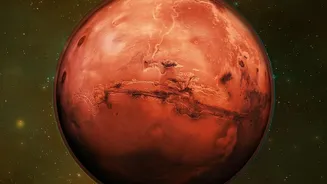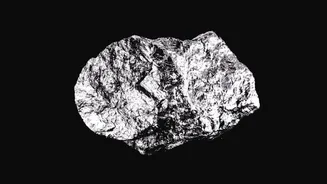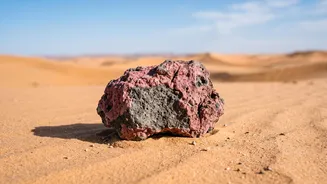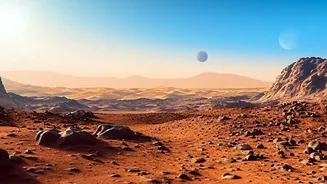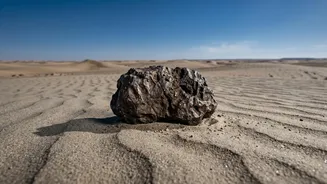




Imagine holding a piece of another world in your hand. A rose-coloured rock, discovered in the Sahara Desert, has turned out to be just that: a messenger from Mars, offering a rare and invaluable snapshot of the Red Planet's deep past.
A Messenger From 4 Billion Years Ago
In 2022, meteorite
hunters found a striking, nearly two-pound rock on a salt plain in Mali. Initially, its origin was a mystery. But after rigorous analysis, scientists confirmed it was not of this Earth. Named Teghaza 001, the meteorite was blasted off the surface of Mars by a powerful asteroid or comet impact millions of years ago, journeyed through space, and eventually landed in our world. What makes this rock truly extraordinary is its age. Using advanced dating techniques on zircon crystals within the meteorite, researchers determined it formed at least 4.1 billion years ago. This makes it one of the three oldest Martian meteorites ever discovered, a pristine relic from the infancy of our solar system when planets were still taking shape.
The Rosetta Stone of Martian Crust
For decades, scientists have been piecing together Mars' history using rovers and orbiters, but physical samples are rare treasures. Of the roughly 435 Martian meteorites found on Earth, most are relatively young, forming less than 2.4 billion years ago. This has created a gap in our knowledge, as much of the planet’s surface is known to be far older. Teghaza 001 helps fill that void. Its unique mineral composition and texture are unlike any other Martian sample studied before. It is a coarse-grained igneous rock, which suggests it cooled slowly from magma deep within Mars's primordial crust. This gives us our first tangible piece of the planet's original foundation, a sample from a region of Mars we've never had access to before. One researcher even dubbed it a 'Rosetta Stone for Mars' because of its potential to unlock the secrets of the planet’s early development.
A Story Written in Minerals and Water
The long-held view was that Mars's crust formed from a simple, uniform magma ocean that cooled and solidified. Teghaza 001 challenges this idea. Its mix of minerals, particularly calcium-rich varieties in unseen proportions, points to a more complex and prolonged process of crust formation. The rock’s chemistry closely matches what NASA’s Mars Reconnaissance Orbiter has observed in the planet's ancient and heavily cratered southern highlands, a region suspected to be part of the original crust. Beyond its fiery birth, the meteorite also tells a watery tale. Analysis revealed that the rock was chemically altered by liquid water around 4.1 billion years ago. This suggests not only that the rock itself is even older, but that a dynamic water cycle was active on Mars far earlier than many models predicted, with hot, mineral-laden fluids circulating through the young crust.
Why This Rock Matters
Understanding how Mars's crust formed isn't just an academic exercise. It helps us answer fundamental questions about planetary evolution and habitability. The evidence of early water interaction locked within Teghaza 001 adds to a growing body of proof that ancient Mars was a much warmer and wetter world than the cold, dry desert we see today. This period of its history, when liquid water was present, is precisely when life was just beginning to emerge on Earth. By studying this ancient fragment, scientists can refine their models of Mars's climate history and investigate why our planetary neighbour lost its water while Earth remained a blue marble. Each clue from this small, well-travelled stone brings us a step closer to understanding the conditions that allow life to arise and whether we were, and are, truly alone in the solar system.