


The Ghost Particles in the Machine
To understand this cosmic drama, we first need to meet the main character: the neutrino. Neutrinos are fundamental particles, but they are notoriously elusive. They have almost no mass, no electric charge, and interact so weakly with other matter that
trillions of them pass through your body every second without leaving a trace. Because of this, they are often called 'ghost particles'. During the cataclysmic collapse of a star's core, an unimaginable flood of neutrinos is unleashed. In fact, about 99% of the immense energy from a collapsing star is carried away by these particles. For decades, astrophysicists have believed that a fraction of this neutrino energy is responsible for powering the final, violent explosion of a supernova. But a complete picture has remained elusive.
A Star's Explosive Choice
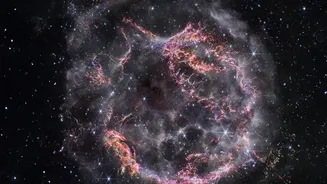
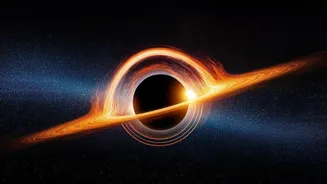
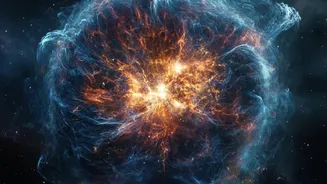
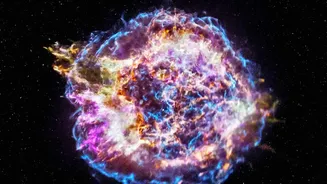
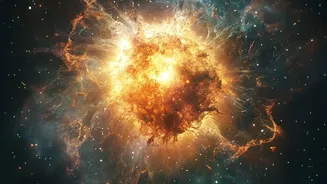
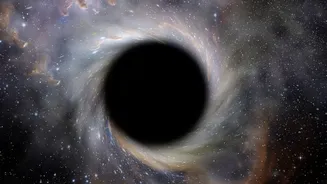
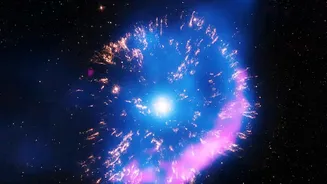
A star many times more massive than our sun spends its life in a constant battle between gravity pulling inward and the outward pressure from nuclear fusion. When it finally runs out of fuel, gravity wins catastrophically. The core implodes in less than a second, crushing protons and electrons together to form neutrons and releasing that torrent of neutrinos. This collapse creates a powerful shockwave. In theory, this shockwave should blast the star's outer layers into space in a supernova, leaving a dense neutron star behind. But in many computer models, this shockwave stalls. The star doesn't explode. Instead, the entire mass continues to collapse into a black hole. For years, scientists have wrestled with one of the biggest unanswered questions in astrophysics: what decides a star's fate?
A Quantum Identity Crisis
The plot twist lies in a strange quantum behavior called neutrino oscillation. Neutrinos come in three types, or 'flavors': electron, muon, and tau. The groundbreaking discovery, which earned the 2015 Nobel Prize in Physics, was that neutrinos can spontaneously change from one flavor to another as they travel. Until recently, most scientists assumed these flavor changes, or oscillations, played a negligible role in the chaos of a supernova. However, new theories suggested that in the incredibly dense environment of a dying star, where neutrinos are packed together, they can interact with each other and trigger rapid, collective flavor changes. This realization prompted researchers to ask a new question: what if this quantum shape-shifting was a key factor in the explosion mechanism itself?
Simulating a Cosmic Coin Flip
To test this idea, a team of astrophysicists from the University of Copenhagen's Niels Bohr Institute ran a massive suite of computer simulations. They modeled the collapse of 195 different stars, with masses ranging from nine to 120 times that of our sun. The critical step was to compare models that included these rapid neutrino flavor conversions with standard models that did not. By doing so, they could isolate the effect of the oscillations on the star's final moments. According to Mariam Gogilashvili, lead author of the study, seeing the clear pattern emerge across so many simulations confirmed that neutrino flavor conversion is something that cannot be ignored when trying to understand how massive stars end their lives.
Flipping the Star's Final Fate
The results were surprising. The study found that including neutrino oscillations made it significantly less likely for some stars to explode. For a key group of stars—those between 16 and 30 times the mass of the sun—many that would have comfortably exploded in standard simulations instead failed to do so and collapsed directly into black holes. This discovery could help solve a long-standing cosmic mystery known as the 'supernova rate problem': astronomers observe far fewer supernovae in the universe than theoretical models predict. This research suggests an answer: many of these 'missing' supernovae may not be missing at all. They are simply collapsing quietly into black holes, a fate dictated by the subtle physics of neutrinos.