


The Mystery of the Little Red Dots
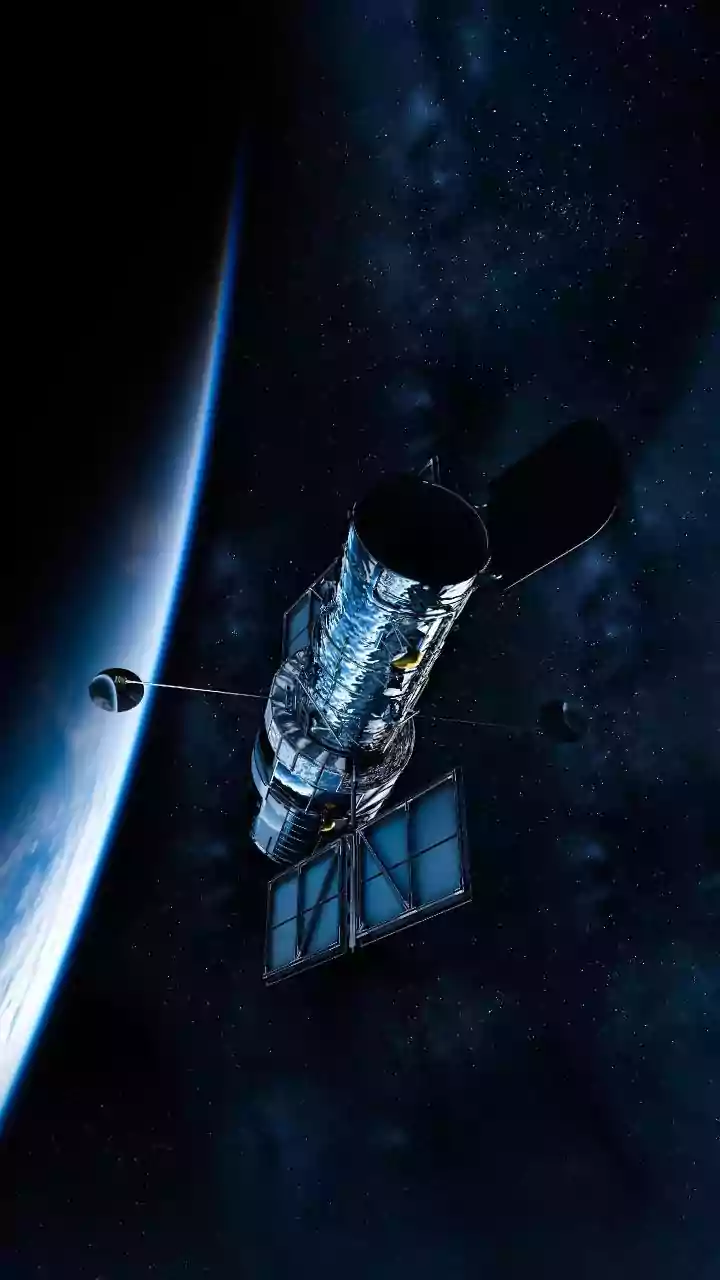
Since it began operations, the JWST has been capturing breathtaking images of the early universe. In these deep-field views, astronomers have repeatedly noticed something odd: tiny, intensely bright red specks of light. Dubbed 'little red dots', these objects
date back to just a few hundred million years after the Big Bang. The puzzle is that they are far too bright and massive to be ordinary stars, yet they don't quite behave like the supermassive black holes we see at the centre of galaxies today. Their redness often suggests they are shrouded in dust, but analysis of their light signature doesn't fully support that explanation. They were a new class of cosmic mystery, leaving scientists to wonder what could possibly be powering them.
Introducing the Black Hole Star
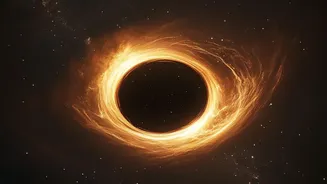
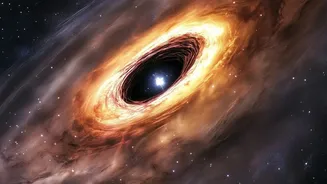
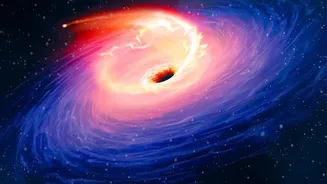
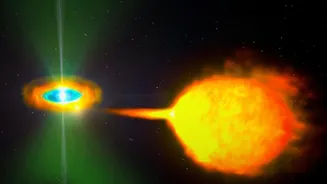
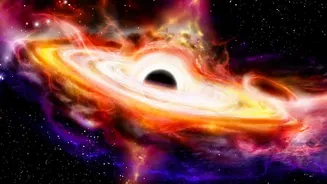
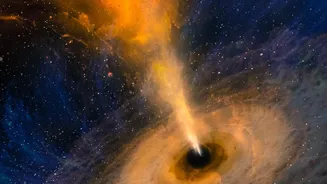
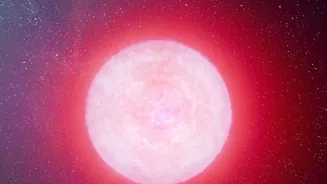
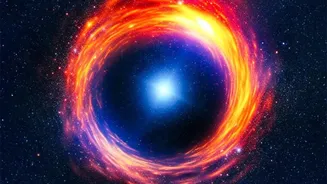
To solve this puzzle, an international team of astronomers has proposed a radical new idea: a completely new type of celestial object they call a 'black hole star'. The concept, also known theoretically as a 'quasi-star', describes a massive object that looks like a star on the outside but is powered by a black hole at its core. Unlike a normal star, which generates energy through nuclear fusion, a black hole star would get its immense luminosity from material falling into a central black hole. The theory suggests a huge, dense cocoon of gas, potentially the size of our entire solar system, would surround a feeding black hole. This gas would get so hot that it would glow intensely, radiating light like a star's surface but on a scale never seen before.
A Candidate Named MoM-BH*-1
The breakthrough came from a detailed study of one specific little red dot named MoM-BH-1. This object was exceptionally bright and red, making it a prime target for investigation. When astronomers analysed its light, they found it was producing about 100 billion times more energy than any known star could physically generate. However, its light spectrum also had features typically associated with the dense gas of a star, not the accretion disk of a regular black hole. The most plausible explanation, the researchers concluded, was that MoM-BH-1 is a black hole star. They believe a black hole around 100,000 times the mass of our sun is hidden inside a star-like envelope of gas. This model perfectly fits the bizarre combination of traits: black-hole-level energy output with star-like light signatures.
Solving a Bigger Cosmic Puzzle
If confirmed, the existence of black hole stars would not only explain the little red dots but could also solve another major problem in cosmology: how supermassive black holes grew so large, so quickly in the early universe. Current models struggle to explain how black holes could reach millions or billions of solar masses in just a few hundred million years. These black hole stars could be the missing link—a transitional phase where a 'seed' black hole grows rapidly by consuming a massive gas envelope before eventually emerging as the supermassive black holes we see in the centre of galaxies like our own Milky Way. In this view, every little red dot could be a nascent supermassive black hole in its infancy, offering an unprecedented look at cosmic evolution.