



A New Eye on the Cosmos
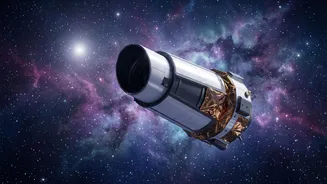
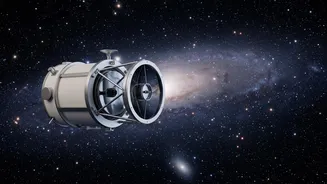
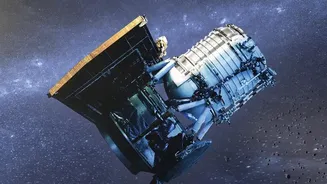
Launched in August 2026, the Nancy Grace Roman Space Telescope is NASA's next great astrophysics observatory, joining the ranks of the Hubble and James Webb Space Telescopes. Named after Dr. Nancy Grace Roman, NASA’s first chief of astronomy and the “Mother
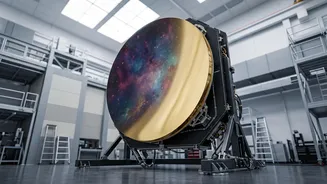
of Hubble,” this mission is designed to tackle some of the biggest questions in cosmology today. Its primary mirror is the same 2.4-meter size as Hubble's, but its instrumentation is engineered for a completely different task. Rather than zooming in on single, specific targets, Roman is built for cosmic cartography—mapping vast stretches of the universe with unprecedented speed and scale. Its five-year primary mission will see it journey to a stable orbit about 1.5 million kilometers from Earth, a vantage point where it can begin its grand survey.
The Power of the Panorama
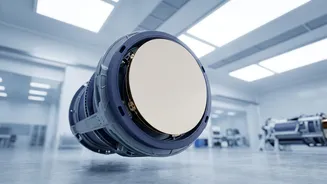
The telescope's headline feature is its Wide-Field Instrument (WFI), a groundbreaking 300.8-megapixel camera. This instrument gives Roman a field of view at least 100 times larger than Hubble’s infrared camera, and some estimates suggest it could be as much as 200 times greater. This means that in a single snapshot, Roman can capture an area of the sky that would require hundreds of individual images from Hubble. This incredible efficiency transforms the observatory from a precision tool into a survey machine. Astronomers predict that Roman will be able to survey the sky a thousand times faster than Hubble, generating enormous datasets that will help answer big-picture questions about the cosmos. In just one month, Roman could survey a portion of our Milky Way galaxy that would take Hubble a century to complete.
Solving the Universe's Darkest Mysteries
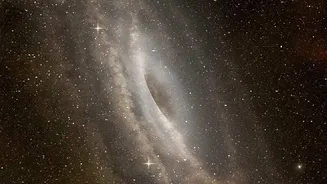
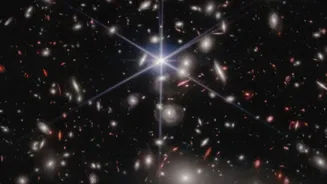
Two of the biggest puzzles in modern astronomy are dark energy and dark matter. Dark energy is the mysterious force causing the universe's expansion to accelerate, while dark matter is the unseen substance that provides the gravitational scaffolding for galaxies. Roman is poised to shed new light on both. By imaging over a billion galaxies, the telescope will create vast 3D maps of the universe's structure. Scientists will study how the distribution of galaxies has changed over cosmic time and measure the distorted light from distant galaxies—a phenomenon called weak gravitational lensing—to trace the influence of both dark energy and dark matter. These large-scale surveys are only possible because of Roman's immense field of view, allowing it to gather the statistical data needed to test our cosmological models.
A Census of Unseen Worlds
Beyond cosmology, Roman will be a prolific planet-hunting machine. While missions like Kepler found thousands of exoplanets by watching for the dimming of starlight as a planet passes in front, Roman will primarily use a different technique called gravitational microlensing. This method detects planets by observing how their gravity, and that of their host star, bends and magnifies the light from a more distant, background star. This technique is sensitive to planets further from their star, including worlds that may be more analogous to the outer planets of our own solar system. The mission is expected to discover thousands of new exoplanets, from massive gas giants to worlds with less mass than Earth, creating a comprehensive census of planetary systems throughout our galaxy. Additionally, Roman carries a technology demonstrator, a Coronagraph Instrument, designed to block starlight to directly image Jupiter-like planets around nearby stars.