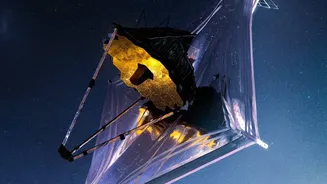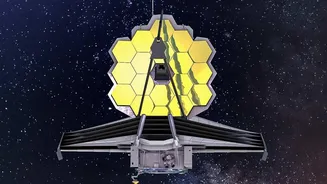






Imagine a time machine, not of science fiction, but of glass and metal, floating a million miles from Earth. That is the essence of NASA's Nancy Grace Roman Space Telescope, a next-generation observatory designed to peer across the universe.
A New Window on the Cosmos
The Nancy
Grace Roman Space Telescope, which successfully launched in August 2026, is the newest flagship observatory in NASA's fleet, joining titans like the Hubble and James Webb Space Telescopes. While Hubble provides stunningly detailed images and Webb peers deep into the infrared to see the earliest moments of the universe, Roman's super power is its immense field of view. It's built for speed and scale. With a primary mirror the same size as Hubble's, Roman can capture an area of the sky at least 100 times larger in a single snapshot, all while maintaining similar sharpness. Think of it this way: if Hubble and Webb are like microscopes, providing a close-up on a specific cosmic specimen, Roman is a panoramic camera, designed to map vast celestial landscapes. This capability will allow it to survey the sky up to 1,000 times faster than Hubble.
Looking Back Through Time
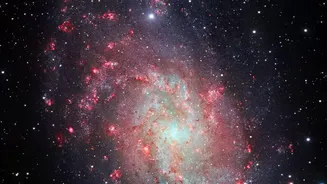
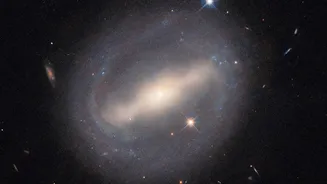
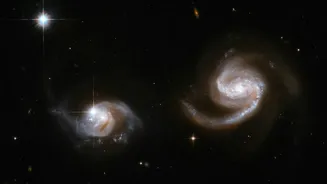
A telescope is fundamentally a time machine. Because light travels at a finite speed, the light we see from a distant galaxy didn't leave yesterday; it left millions or even billions of years ago. The farther away we look in space, the further back we see in time. A galaxy one billion light-years away appears to us as it was one billion years ago. The Roman observatory is engineered to exploit this principle on an unprecedented scale. By capturing light from galaxies at various distances, from our cosmic neighbourhood to the far reaches of the universe, astronomers can effectively assemble a photo album of the cosmos. This album will feature snapshots of galaxies in their infancy, their turbulent teenage years, and their mature adulthood, allowing for a direct comparison across different epochs.
The Ultimate Galactic Census
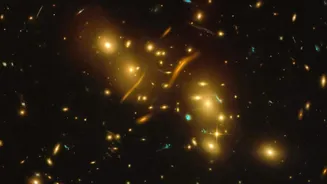
At the heart of Roman's mission is the High-Latitude Wide-Area Survey (HLWAS). This ambitious project will map roughly 12 percent of the sky over its five-year primary mission, capturing images and data from potentially a billion galaxies. The survey combines two powerful techniques: imaging and spectroscopy. Imaging will reveal the position, shape, and size of hundreds of millions of galaxies. Spectroscopy, which breaks light down into its component colors, allows astronomers to determine a galaxy's distance, composition, and how fast it's moving away from us. This combination of a wide, deep, and three-dimensional view will provide a treasure trove of data. Where previous telescopes could study tens of very distant 'high-redshift' galaxies, Roman will be able to sample thousands, providing the statistical power needed to understand cosmic trends.
From Cosmic Infants to Adults
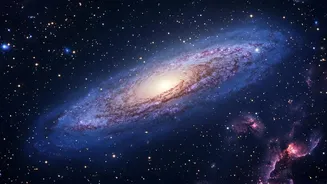
With this vast dataset, astronomers can group galaxies by their distance, and therefore by their age, to see how they have evolved. It's like studying a forest by not just looking at one tree, but by cataloging saplings, young trees, and ancient giants all at once to understand the entire life cycle. Scientists will be able to compare the star formation rates, sizes, and structures of galaxies from when the universe was just a few billion years old to the present day. This will help answer fundamental questions: Did galaxies grow primarily by merging with other galaxies, or by slowly accumulating gas from their surroundings? How did the majestic spiral arms of galaxies like our own Milky Way form? Roman will also help map the mysterious 'cosmic web'—the vast, filamentary structure of dark matter along which galaxies are thought to form and cluster.
Unlocking Universal Mysteries
Beyond charting the growth of galaxies, Roman's wide-angle view is perfectly suited to tackling some of the biggest mysteries in physics: dark energy and dark matter. Together, these two invisible components are believed to make up about 95% of the universe. Dark matter's gravity holds galaxies together, while dark energy is the enigmatic force causing the universe's expansion to accelerate. By precisely measuring the positions and shapes of millions of galaxies across cosmic time, Roman will create a 3D map of the universe's structure. This map will show how dark energy's influence has changed over billions of years and reveal how dark matter is distributed on the largest scales, providing crucial data to test our understanding of gravity and the ultimate fate of the cosmos.