




A Cosmic Somersault
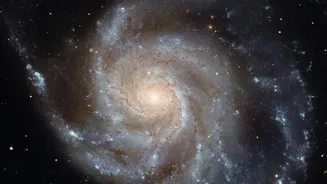
Imagine our entire galaxy, a sprawling disc of hundreds of billions of stars, slowly but surely tilting over by more than 90 degrees. This isn't science fiction, but a compelling theory presented by astronomers to explain some of the Milky Way’s most
puzzling features. According to new research presented at the 2026 National Astronomy Meeting, our galaxy may have performed this colossal somersault billions of years ago, long before our Sun and Earth ever existed. This 'disc flip' wasn't an instantaneous event like flipping a coin, but a gradual reorientation of the entire galactic disc over hundreds of millions or even billions of years.
Following Stellar Breadcrumbs
Scientists can't travel back in time, so how did they uncover this ancient upheaval? The clues lie in the stellar halo, a sparse, spherical cloud of ancient stars that surrounds our galaxy’s main disc. While stars in the disc, like our Sun, orbit the galactic center at a brisk 220 kilometers per second, the stars in the halo move much more slowly, at only about 10 to 20 kilometers per second. This discrepancy has long puzzled astronomers. A team from Durham University used powerful supercomputer simulations to model the evolution of galaxies like ours. They found that galaxies with such slow-moving halos almost always had two things in common: they had undergone a major, head-on collision with another galaxy, and their disc had flipped.
The Gaia Sausage Collision
The prime suspect for this cosmic disruption is a dwarf galaxy known to astronomers as Gaia-Sausage-Enceladus, or the 'Gaia Sausage' for short. This name comes from the elongated, sausage-like shape formed by the orbits of its former stars, which were discovered using data from the European Space Agency's Gaia satellite. Around 8 to 11 billion years ago, this smaller galaxy slammed into the young Milky Way. A 'collision' between galaxies isn't like a car crash; the vast distances between stars mean very few actually hit each other. Instead, the immense gravitational forces of the merger tore the Gaia Sausage galaxy apart, scattering its stars into what is now our stellar halo and unleashing enough gravitational torque to gradually tilt the entire Milky Way disc.
Rewriting Our Cosmic History
This theory of a galactic flip provides an elegant solution to the mystery of the slow-rotating halo. The violent merger essentially scrambled the original orientation of the galaxy, and the halo still carries the 'memory' of that ancient event. The finding is part of a growing field called galactic archaeology, where astronomers use the positions, movements, and chemical compositions of stars to piece together our galaxy's history. This new evidence suggests the Milky Way's evolution was far more dynamic than previously thought. Other independent studies have found related evidence, such as a discovery that the Milky Way’s vast, invisible dark matter halo appears to be tilted almost perpendicularly to the stellar disc, which could also be a result of the same reorientation.