







The Search for Analogue Calm
Our daily lives are saturated with notifications, emails, and endless scrolling. This constant stimulation can leave us feeling frazzled, anxious, and disconnected from the present moment. It's no surprise that many people are seeking refuge in analogue
hobbies—activities that engage our hands and quiet the mental chatter that technology often amplifies. Among these, the ancient art of pottery is having a modern resurgence, not just as a craft, but as a form of active meditation. It offers a tangible escape, a chance to create something real and beautiful in a world that often feels intangible.
How Clay Commands Your Attention
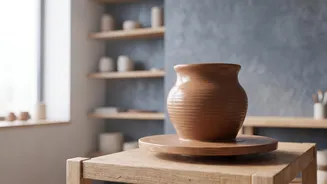
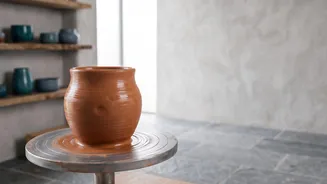
Mindfulness is the practice of being fully present and engaged in the moment, without judgment. Pottery demands exactly this. When your hands are covered in cool, damp clay, you are instinctively pulled into the now. The tactile experience—the texture of the clay, its resistance, and the subtle shifts in moisture—engages the senses in a way that screens cannot. This sensory engagement helps to ground you, quieting the part of your brain that worries about yesterday's mistakes or tomorrow's to-do list. The repetitive motions of kneading clay or centering it on a wheel can be deeply soothing, helping to regulate the nervous system and lower stress hormones like cortisol.
Finding Your 'Flow State'
Psychologists describe 'flow' as a mental state of complete absorption in an activity. It’s that feeling of being “in the zone,” where time seems to disappear and your focus is sharp and effortless. Pottery is a powerful trigger for this state. The process requires a delicate balance of concentration and physical skill, whether you're controlling the speed of the wheel or gently guiding the clay upwards. This intense focus leaves little room for distracting thoughts or anxieties to creep in. The activity provides clear goals and immediate feedback—if you press too hard, the wall collapses—which keeps you fully engaged in the task at hand. This complete immersion is not just satisfying; it’s restorative for the mind.
The Beauty of Imperfection
In many areas of our lives, we strive for perfection. Pottery, however, teaches a different lesson: the value of embracing imperfection. Your first pot will likely be wobbly, lopsided, or collapse entirely. Instead of a failure, this is a fundamental part of the learning process. Clay has its own intentions, and learning to work with it is a dialogue of give and take. This practice of non-judgmental acceptance is a core principle of mindfulness. Celebrating a quirky mug or a charmingly uneven bowl builds resilience and self-confidence, reminding you that the journey is just as important as the finished product.
Getting Started in India
The pottery scene in India is more accessible than ever, with studios in major cities like Mumbai, Delhi, and Bangalore, as well as in quieter craft hubs like Himachal Pradesh and Auroville. Most studios offer beginner-friendly taster workshops that provide a guided introduction to hand-building or wheel throwing. These single sessions, typically costing between ₹1,200 and ₹2,500, are a perfect way to see if you enjoy the feel of clay. From there, you can enroll in longer courses to develop your technique. Look for studios that offer a welcoming environment and hands-on guidance, such as Terracrafts in Kochi, Dhee Pottery in Bangalore, or Aura Pottery near Chandigarh.