




A Tale of Two Galaxies
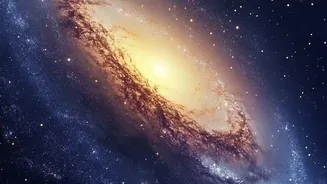
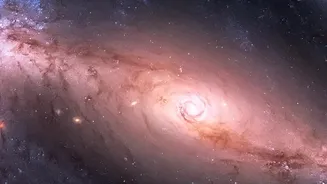
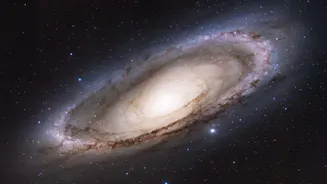
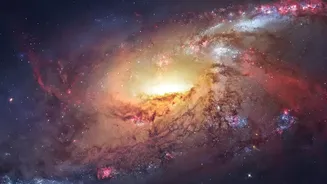
Just 2.5 million light-years away, the Andromeda galaxy is a cosmic sibling to our own Milky Way. Visible to the naked eye as a faint smudge in a dark sky, it's the largest galaxy in our local group and offers astronomers a unique chance to study another
galaxy's life up close. For years, scientists have known that Andromeda and the Milky Way have had very different upbringings despite being neighbours. Andromeda appears to have a more turbulent past, marked by more recent and intense periods of activity. A key part of that activity is 'star birth,' the process where vast clouds of gas and dust collapse to form new suns. Now, it seems Andromeda's most creative era is coming to a close.
Reading the Fossil Record
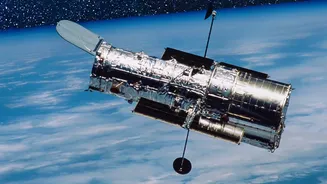
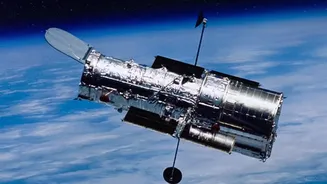
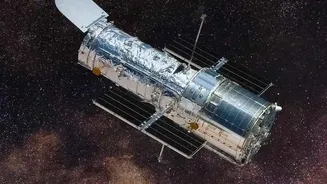
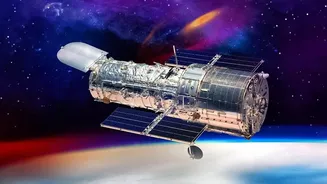
To uncover this story, astronomers turned to the Hubble Space Telescope, the only instrument capable of resolving hundreds of millions of individual stars within Andromeda's sprawling disk. These stars act as a 'fossil record' of the galaxy's history. By analysing the colour of the stars, scientists can tell their age. Massive, young stars burn hot and blue, but have short lives, while older, less-massive stars glow redder and live much longer. The research team meticulously mapped about two-thirds of the galaxy's disk, using data from two massive surveys—the Panchromatic Hubble Andromeda Treasury (PHAT) and its southern counterpart (PHAST)—to build a detailed timeline of its star-forming activity.
The Slowdown and the Sharp Drop
The findings, published in The Astrophysical Journal, show a galaxy that is slowly, but surely, winding down. Over the last 500 million years, Andromeda’s star formation has been in steady decline. About 500 million years ago, it was creating stars at a rate of about one Sun’s mass per year. But by 40 million years ago, that rate had dropped by half. In the time since, it has plummeted even further. Today, Andromeda’s star birth rate is only about one-fifth of a solar mass per year, a shadow of its former self. This recent, sharp decline suggests a significant change in the galaxy's dynamics.
Why Is the Cosmic Nursery Closing?
Interestingly, Andromeda doesn't seem to be running out of the raw materials—the gas and dust—needed to make new stars. Instead, scientists believe the galaxy is in a natural cooling-off period. Previous studies showed Andromeda experienced a massive burst of star formation about 2 billion years ago, likely the result of a merger with another galaxy. Lead author Tobin Wainer compares it to the recovery needed after a major exertion: “It's just like after running a marathon, sometimes you've got to take a bit of a breather.” Much of the recent decline is traced to a fading ring of star formation about 32,000 light-years from the galactic centre.
A Galactic Suspect
While a natural slowdown is the primary explanation, there might be another culprit involved: Andromeda's small satellite galaxy, Messier 32 (M32). Astronomers have long wondered if interactions with M32 have influenced Andromeda. The new data reveals that the area of Andromeda's disk closest to M32 shows an even more pronounced drop in star formation, which began around 60 million years ago. While researchers can't definitively blame M32 for the slowdown, they note it is the “most likely suspect.” This cosmic detective story highlights how even a near-miss between galaxies can have profound consequences.
A Glimpse into Our Own Future?
Studying Andromeda isn't just about understanding a distant neighbour; it provides a valuable template for galactic evolution that helps us understand our own Milky Way. While our galaxy's history appears less violent than Andromeda's, the two are on an inevitable collision course. In about 4.5 billion years, they are predicted to merge. This future collision will compress the remaining gas in both galaxies, likely triggering a final, spectacular burst of star formation before the combined super-galaxy eventually settles into a quiet retirement. By watching Andromeda's current decline, we may be seeing a preview of the long, quiet twilight that awaits all galaxies.