







What Are Hanging Glaciers?
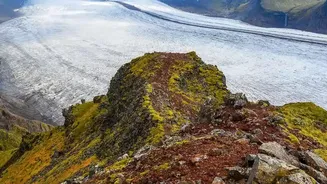
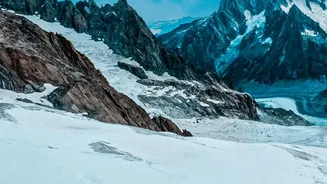
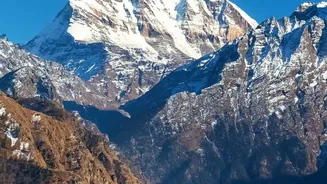
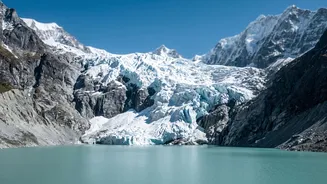
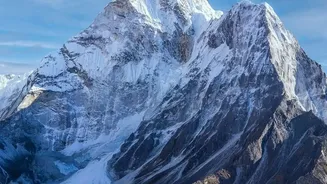
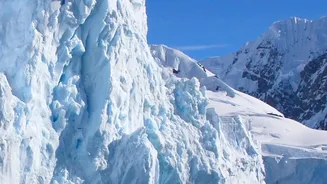
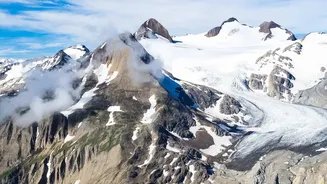
Unlike the vast rivers of ice that carve their way through valleys, a hanging glacier is an ice mass that clings precariously to a steep mountain slope. Often terminating abruptly over cliffs, their position makes them inherently unstable. As the ice grows
heavy or its bond to the underlying rock weakens, huge sections can break off without warning, triggering powerful ice and rock avalanches. A recent study published in a 'Nature' journal identified 219 such glaciers across Uttarakhand's Alaknanda basin. This comprehensive inventory has provided crucial, and alarming, new data on a little-understood Himalayan hazard.
A Startling Discovery in the Alaknanda
The study, conducted by researchers from prominent Indian institutions like IISc and IIT, discovered that the Alaknanda basin holds an estimated 2.39 cubic kilometres of ice in these hanging glaciers. More critically, nearly a third of this ice mass is considered highly unstable and prone to collapse. The highest concentration, around 30 percent of the unstable volume, is located in the Upper Alaknanda basin. This region includes the critical pilgrimage town of Badrinath and Mana, the last village on the India-China border, placing them in a zone of significant risk. The scientists flagged that rapid warming is increasing the "geometric and dynamic instability" of these glaciers.
The 50-Metre Flow Simulation
The headline figure comes from advanced avalanche simulations run by the researchers. These models projected what would happen if one of these unstable glaciers were to collapse. The results were chilling: in the Badrinath-Mana sector, the height of a resulting avalanche flow could exceed 50 metres. A flow of such magnitude would be a colossal wall of ice, rock, and debris, capable of overwhelming entire settlements and destroying critical infrastructure like roads and bridges. The simulations showed that key locations like Badrinath, Mana, and Hanuman Chatti could be directly impacted. This isn't a distant, abstract threat; it's a specific, modelled danger for one of India's most important pilgrimage routes.
A Cascade of Catastrophe
The danger doesn't stop with the initial avalanche. A major collapse can trigger a deadly chain reaction, what scientists call a 'multi-hazard cascade'. The falling debris can dam a river, creating a temporary and highly unstable lake. When this dam inevitably bursts, it releases a devastating flash flood downstream. This is precisely the kind of cascading disaster that occurred during the 2021 Chamoli tragedy, where a hanging glacier collapse led to a flash flood that killed over 200 people and wiped out two hydropower projects. The study warns that these hanging glaciers present the same potential for creating secondary disasters like glacial lake outburst floods (GLOFs).
A Region of Growing Risk
The threat is being multiplied by human activity. The study highlights that the risk is not just from the glaciers themselves, but from the rapid and often unplanned development in these high-altitude zones. Researchers project that by 2030, the amount of built-up area and infrastructure within these vulnerable zones will be 120 percent higher than it was in 2000. The population exposed to these hazards is expected to surge concurrently. As the Himalayas warm faster than the global average, the repeated freezing and thawing of ice weakens the glaciers, making collapses more likely. Scientists from the Wadia Institute of Himalayan Geology have confirmed that climate change is a primary factor behind this increasing instability.