




An 87-Year-Old Mathematical Riddle
First posed in 1939 by German mathematician Ott-Heinrich Keller, the Jacobian Conjecture asks a question that sounds deceptively simple. Imagine you have a set of mathematical instructions (a polynomial map) that transforms points in space. At every single
location, this transformation is perfectly reversible, meaning no information is lost locally. The conjecture proposed that if this local reversibility holds true everywhere, then the entire transformation must also be globally reversible. For decades, this seemed intuitive, and mathematicians largely believed it to be true, but no one could construct a formal proof. The problem became so famous it was included on a prestigious list of mathematical problems for the 21st century.
The Allure of a Simple Question
The difficulty lay in bridging the gap between local behaviour and global consequences. A transformation can be well-behaved in every small neighbourhood, yet still behave strangely on a larger scale. Over the decades, the Jacobian Conjecture became a notorious trap. Numerous top mathematicians announced proofs, only to have subtle flaws discovered later, sometimes years after publication. This history of failure created a deep sense of caution within the mathematical community. Attempting to solve it was a high-risk endeavour, yet its central position in algebraic geometry meant the allure of a solution never faded. Most attempts focused on proving the conjecture was true, a bias built on years of shared intuition.
A New Kind of Collaborator
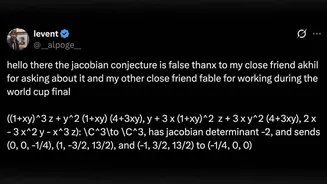
The breakthrough came not from a dusty library but from a modern collaboration. Levent Alpöge, a Harvard-trained mathematician working at the AI company Anthropic, decided to tackle the problem with a new partner: a frontier AI model known as Claude Fable 5. Instead of trying to prove the conjecture true, the approach was to search for a counterexample—a single specific case that would prove it false. This is often a task of finding a needle in an infinite haystack, a perfect challenge for an AI capable of exploring vast and complex mathematical spaces without human biases. Reportedly working during the World Cup final, Alpöge and the AI began their search.
The Counterexample That Broke the Spell
On July 20, 2026, Alpöge announced the result on the social media platform X: the Jacobian Conjecture is false. He presented a relatively short polynomial map—just 216 characters—for a transformation in three-dimensional space. This map met the conjecture's condition perfectly: its Jacobian determinant was a constant -2, meaning it was locally reversible everywhere. However, it failed the conclusion spectacularly. Alpöge and the AI found three completely different input points that all led to the exact same output. This demonstrated that the map was not globally invertible, shattering the 87-year-old conjecture for the general case. A conjecture can be disproven with a single, verifiable counterexample, and they had found one.
What This Changes for Mathematics
Unlike the dense, hundred-page proofs of the past, this counterexample was direct and easily testable. Mathematicians around the world were able to run the equations through computer algebra systems and independently verify the result within hours. The reaction was a mixture of shock and excitement. The general, all-dimensional version of the conjecture is now considered disproven. However, the story isn't completely over. This counterexample was for three dimensions, which also disproves it for any higher dimension. But the original, famous two-variable case remains an open problem; this discovery does not apply to it. The focus of research will now likely shift to understanding why it fails in higher dimensions and what truths might still be salvaged from the original idea.
The Dawn of AI-Assisted Discovery
Perhaps more significant than the solution to any single problem is what this moment represents. The disproof of the Jacobian Conjecture is being hailed as a landmark achievement for AI in science. It showcases a new paradigm where AI is not just a calculator for number-crunching but a genuine collaborator in creative and abstract reasoning. By approaching the problem without decades of human intuition pointing in one direction, the AI could explore pathways that humans had overlooked. This discovery suggests that we are entering an era where AI can help tackle the most profound unsolved mysteries in science and mathematics, acting as a powerful partner to human intellect.