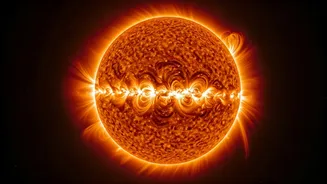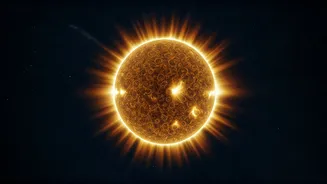






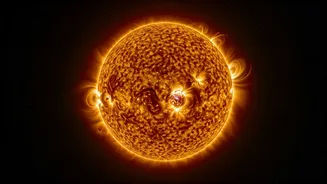
A Sun Without Spots
Between roughly 1645 and 1715, astronomers noticed something strange: the Sun went quiet. Sunspots, which normally follow a predictable 11-year cycle of waxing and waning, became exceedingly rare. In a typical modern 30-year span, we might see tens of thousands
of sunspots; during one 28-year stretch of the Maunder Minimum, observers counted fewer than 50. This solar silence coincided with the coldest part of the “Little Ice Age” in the Northern Hemisphere, a period of harsh winters that saw London's River Thames freeze over. While a direct cause-and-effect is still debated by scientists, the correlation has made the Maunder Minimum a crucial puzzle piece for understanding the Sun's influence on Earth's climate.
The Core of the Mystery
The great mystery wasn't just that the sunspots disappeared, but why, and what the Sun was truly doing. Did its internal magnetic dynamo, the engine that drives its activity, simply shut down? Or did it shift into a different, more subtle mode that early astronomers, with their newfangled telescopes, weren't equipped to see? For a long time, some historians argued that the lack of sunspot records was simply due to sparse and haphazard observations. However, work by astronomer John A. Eddy in the 1970s confirmed the lull was real, using indirect evidence like the levels of carbon-14 in tree rings, which are affected by solar activity. This left the central question unanswered: what was really happening to our star during this extended quiet spell?
Clues in the Night Sky
To solve this historical puzzle, scientists are becoming historical detectives. One of the most exciting breakthroughs comes not from telescope logs, but from ancient Korean royal journals. During the Joseon dynasty, court historians kept meticulous records of celestial events, including sightings of aurorae, the northern and southern lights. Because aurorae are caused by solar particles interacting with Earth's atmosphere, their frequency is a good proxy for solar activity. A 2023 study analyzing these records found something remarkable: aurorae were still seen during the Maunder Minimum, and their appearances suggested the solar cycle hadn't stopped, but had shortened to a brisk 8 years. This suggests the Sun's dynamo wasn't off; it was operating in a completely different gear.
Rewriting the Solar Timeline
Other researchers are looking back at the work of the giants of early astronomy. A 2024 study revisited the work of none other than Johannes Kepler. By re-examining Kepler's half-forgotten sunspot drawings from 1607, decades before the minimum began, scientists were able to more accurately date the solar cycles leading up to the great quiet. These old sketches provided new information that challenged previous reconstructions of the Sun’s behaviour, helping to create a more precise timeline of how the Sun transitioned into its unusual state. It shows how even centuries-old data can yield fresh insights when viewed with modern understanding, turning historical archives into active scientific resources.
Why This Solar Detective Work Matters
Understanding the Maunder Minimum is more than an academic exercise. A more complete picture of how the Sun behaves during grand minima helps scientists refine models of solar physics and climate. Knowing that the Sun can shift its cycle length, for example, is a crucial piece of information for predicting future solar behaviour. This has practical implications for our technologically dependent society. Strong solar activity can disrupt satellites and communications, so knowing the full range of the Sun’s potential behaviour is vital. Furthermore, by studying our own Sun's strange past, and even observing other Sun-like stars that appear to be entering their own minima, scientists can better understand the forces that govern stars throughout the galaxy.