



The Celestial Navigation Problem
For decades, navigating in space has relied on a complex and time-consuming process of communication with Earth. Ground stations meticulously track a spacecraft's position and relay that information back. This method, while proven, is slow and resource-intensive.
It is not suitable for the dynamic, real-time needs of astronauts and rovers traversing the lunar surface. During the Apollo missions, astronauts faced difficulties judging distances to landmarks like craters, a task made harder by the lack of an atmosphere. For NASA's Artemis program, which aims to establish a sustainable human presence on the Moon, a more robust and autonomous navigation system is not just a convenience—it's a necessity for safety and efficiency.
A GPS For The Moon
Enter the Lunar GNSS Receiver Experiment (LuGRE). This joint project between NASA and the Italian Space Agency (ASI) is designed to test whether signals from Global Navigation Satellite Systems (GNSS)—like the GPS we use on Earth—can be used for navigation on and around the Moon. The goal is to provide spacecraft, and eventually astronauts, with the ability to calculate their own position, velocity, and time, independent of Earth-based controllers. The experiment recently achieved a major milestone, successfully acquiring signals and calculating a navigation fix on the lunar surface for the first time. This demonstrates that using Earth's existing satellite infrastructure for lunar navigation is a viable concept.
Catching Faint Signals from Far Away
The satellites that make up constellations like GPS and Europe's Galileo system are designed to broadcast their signals toward Earth. However, a portion of these signals radiates out into space. The challenge for a lunar receiver is its ability to pick up these much weaker, spill-over signals from over 385,000 kilometers away. The LuGRE payload, and follow-up technologies like the NavCube3-mini, use highly sensitive receivers and high-gain antennas pointed toward Earth to capture and process these faint signals. These receivers are designed to track signals from multiple satellite constellations simultaneously, increasing the number of available signals and improving the accuracy of the position fix. This technology effectively stretches the reach of Earth's existing multi-billion dollar navigation infrastructure all the way to the Moon without needing to launch a new lunar-specific satellite network, at least for now.
Why Precision and Autonomy Matter
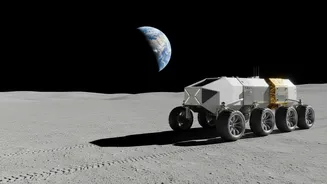
Having a real-time, on-board navigation system will transform lunar exploration. It enables a level of autonomy that is critical for the ambitious goals of the Artemis program. Astronauts and robotic rovers could navigate the lunar surface with the same ease as using a car's GPS, allowing for more complex scientific traverses and exploration of challenging terrain, like the shadowed craters of the lunar South Pole. This capability also frees up valuable bandwidth on NASA's Deep Space Network, as constant communication for tracking purposes would no longer be necessary. Furthermore, precise navigation is essential for automated and safe landings, enabling missions to target scientifically interesting locations with pinpoint accuracy, a feat that was much harder in the past.
Building the Future Lunar Economy
This advancement in navigation is a foundational piece of infrastructure. Much like GPS enabled countless industries and applications on Earth, from logistics and agriculture to location-based services, a reliable lunar positioning system is seen as an essential utility for a future lunar economy. It supports not just NASA's scientific goals but also the activities of commercial partners. Companies like Firefly Aerospace and Intuitive Machines, part of NASA's Commercial Lunar Payload Services (CLPS) initiative, are already involved in deploying these technologies. As NASA and its international and commercial partners work to build a sustained presence on the Moon, this GPS-like capability will underpin everything from constructing habitats to mining resources and conducting long-term science experiments, laying the groundwork for a bustling cislunar ecosystem.