





A Geological Detective Story
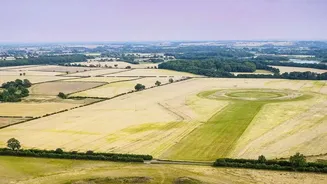
There are no volcanic cones or lava fields visible on the surface today. This ancient giant is completely buried under younger rock layers. Its discovery is a triumph of modern geological science, solving a long-standing mystery. For decades, geologists
have known about a thick layer of volcanic ash, called the Kinnekulle tephra, found across Scandinavia, Poland, and the Baltic region. The puzzle was its origin; no known volcano seemed to fit. The breakthrough came when scientists from the British Geological Survey and the University of Oslo re-examined rock samples taken from deep boreholes in Norfolk and Lincolnshire decades ago. Using advanced techniques, they analysed tiny zircon crystals, which act like geological clocks. These crystals revealed an age of approximately 454.4 million years, a near-perfect match for the age of the Scandinavian ash layer. This confirmed that an enormous volcanic eruption in what is now England was the source, sending a colossal ash plume across the ancient Tornquist Sea.
A World Lost in Time
To picture this volcano, we must travel back 454 million years to the Late Ordovician period. The world was unrecognisable. The landmass that would become England was part of a microcontinent called Avalonia, located in the Southern Hemisphere. It was separated from what would become Scandinavia by the Tornquist Sea. This region was part of a dynamic volcanic arc, similar to the 'Ring of Fire' in the Pacific Ocean today, where tectonic plates collided. This collision zone created a chain of volcanoes. While many of the UK's ancient volcanoes are known in more rugged areas like the Lake District and Wales, this discovery places a massive volcanic complex right under England's east coast. It wasn't just a single cone, but likely a vast system of calderas, now named the Wash Igneous Complex.
An Eruption of Unimaginable Force
The eruption that created the Kinnekulle tephra was cataclysmic. Scientists estimate that hundreds, possibly thousands, of cubic kilometres of rock, ash, and gas were blasted into the stratosphere. The force would have been equivalent to several thousand powerful hydrogen bombs, making it one of the largest eruptions in Earth's history. The sky would have darkened for immense distances as the ash cloud travelled across the sea to settle on the ocean floor of ancient Scandinavia. On the ground, the eruption would have produced devastating pyroclastic flows—superheated avalanches of gas and debris racing across the landscape. While some reports have used the term 'supervolcano', some experts are cautious, noting that it's difficult to calculate the exact eruption volume due to the poor preservation of the deposits. Regardless of the label, the event was undeniably colossal.
Why This Ancient Volcano Matters Today
This discovery does more than just solve a geological puzzle; it reshapes our understanding of England's deep past. It confirms that the region was once far more geologically violent than its tranquil modern appearance suggests. The research showcases the incredible value of geological archives, as the rock samples that provided the key evidence were collected 80 years ago and awaited modern analytical techniques to reveal their secrets. There is no threat of this volcanic system reawakening; it is completely extinct, buried and cooled over hundreds of millions of years. Understanding these deep, ancient structures can, however, have practical implications today. Knowledge of deep underground formations is crucial for exploring geothermal energy resources and for safely assessing locations for things like carbon capture and storage. This ghost of a volcano, therefore, not only tells a story of the past but may also inform the future.