

Understanding the Celestial Dance
So, what exactly is an evening elongation? It sounds complex, but the concept is quite simple. Venus is an 'inferior planet', which means its orbit is closer to the Sun than Earth's. Because of this, from our viewpoint, Venus never strays far from the Sun's
glare. We only ever see it for a few hours after sunset or before sunrise, earning it the nicknames 'Evening Star' and 'Morning Star'. An elongation is the angular separation between the Sun and a planet. On August 15, 2026, Venus reaches its 'greatest eastern elongation'. This is the point in its orbit when it appears farthest from the Sun in our evening sky, making it the best time to observe it. This cycle, where Venus swings from an evening star to a morning star and back, takes about 584 days.
How to See Venus From India
The good news for sky-watchers in India is that this event is incredibly easy to witness. You don’t need any special equipment—no telescope, no binoculars. Simply find a spot with a clear view of the western horizon and look up shortly after sunset. You cannot miss Venus. It will be the most brilliant, steady point of light hanging in the twilight. On this date, Venus will shine at a dazzling magnitude of -4.4, making it brighter than any star in the sky and easily visible even before complete darkness falls. If you do happen to have a telescope, you'll be rewarded with a fascinating sight: Venus will appear as a tiny, perfect half-moon, showing about 49% of its surface illuminated. The planet will remain a prominent feature in the evening sky through October, though this peak elongation marks its highest climb away from the setting Sun.
A Storied History in the Sky
Long before we understood the science, Venus captivated humanity. Its reliable appearance in the morning and evening made it a fixture in mythology and early astronomy. The ancient Romans named it after their goddess of love and beauty, a tradition that followed the Greek name, Aphrodite. It is the only planet in our solar system named for a female figure. But its dual role as a morning and evening star led some cultures to believe they were two different objects. For early scientists like Galileo Galilei, Venus provided revolutionary proof. When he observed Venus through his telescope in the 17th century, he saw it went through phases just like our Moon. This could only be possible if Venus orbited the Sun, not the Earth. This simple observation was a crucial piece of evidence that helped dismantle the Earth-centric model of the universe and confirm that the planets, including our own, revolved around the Sun.
The Beautiful but Inhospitable Twin
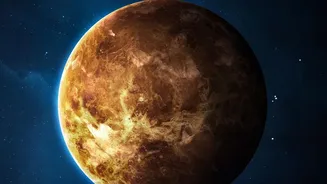
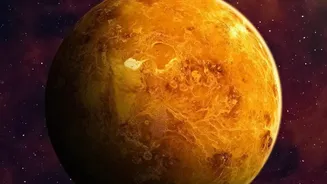
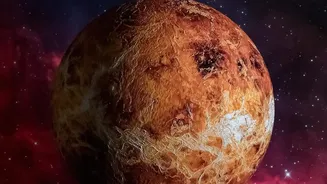
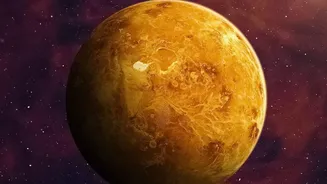
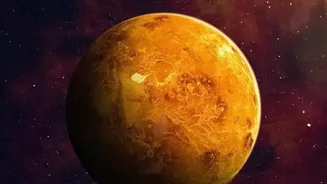
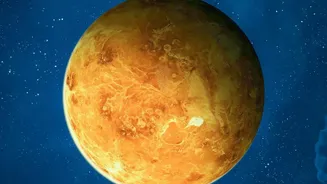
For all its beauty as a distant point of light, the reality of Venus is far from lovely. It is often called Earth’s 'twin' because of its similar size and structure, but it’s more of an 'evil twin'. The planet is shrouded in a thick, toxic atmosphere of carbon dioxide, which creates a runaway greenhouse effect. This traps heat, making Venus the hottest planet in our solar system, with surface temperatures high enough to melt lead. The atmospheric pressure at its surface is over 90 times that of Earth at sea level, equivalent to the pressure found deep in our oceans. Its perpetual cloud cover is made of sulfuric acid. This stark contrast between its serene appearance in our sky and its hellish surface conditions is one of the most compelling stories in our solar system.