



Our Sun's Protective Bubble
Imagine our solar system speeding through the galaxy. As it does, the Sun constantly emits a stream of charged particles called the solar wind. This solar wind travels outwards at supersonic speeds, creating a massive magnetic bubble called the heliosphere.
This bubble acts as a shield, deflecting many harmful cosmic rays from interstellar space. For everything within it, from Earth to the farthest probes, the heliosphere is the local environment. But like a ship pushing through water, this bubble has a boundary where its influence wanes.
The Heliopause: The Edge of a Solar Neighborhood
The theoretical edge of this bubble is known as the heliopause. It is the point where the outward push of the Sun's solar wind is no longer strong enough to push back against the pressure of the interstellar medium—the mix of gas, dust, and cosmic rays that fills the space between stars. At this boundary, the solar wind effectively stops. NASA’s Voyager 1 and Voyager 2 spacecraft confirmed this when they crossed the heliopause in 2012 and 2018 respectively, sending back data showing a dramatic change in their environment. They are the first human-made objects to enter interstellar space.
The Universe’s Invisible Ingredient
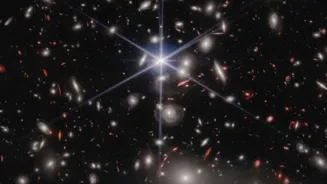
To understand the new theory, we first need to talk about dark matter. While it makes up about 27% of the universe, we can't see or touch it. It doesn't emit, absorb, or reflect any light. Scientists know it exists because of its powerful gravitational effects, which are necessary to explain why galaxies don't fly apart and how the universe is structured on a large scale. Think of it as the invisible scaffolding that gives the cosmos its shape. It’s believed to form vast, spherical 'halos' around galaxies, including our own Milky Way.
A New Theory: Dark Matter at the Boundary
While dark matter is typically thought of as being spread out, some theories propose it might clump together on smaller scales than entire galaxies. Several researchers have explored the idea that dark matter could be gravitationally captured by the solar system or even individual planets. The headline-making theory builds on this, suggesting that dark matter could accumulate or have a more pronounced gravitational effect at the heliopause. Instead of being perfectly smooth, the boundary of our solar system might be influenced by the gravitational pull of these unseen particles. This could help explain certain unexpected features or the stability of the heliosphere's structure that current models don't fully account for.
Searching for Local Clues
Proving this theory is a monumental task. The density of dark matter in our solar system is thought to be extremely low, making its gravitational effects on planets almost negligible and currently undetectable. However, some scientists propose that if dark matter can form dense, compact halos, its density could be much higher in specific locations, such as bound to the Sun or Earth. Researchers are analysing planetary orbits and the trajectories of spacecraft for tiny, anomalous deviations that could point to the gravitational influence of unseen matter. Finding such evidence within our own solar system would be a revolutionary breakthrough, providing the first 'local' confirmation of dark matter's presence and fundamentally changing our models of the cosmos.