




A Martian Geological Puzzle
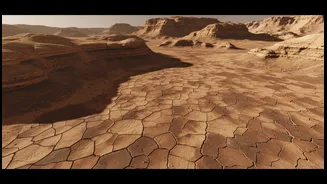
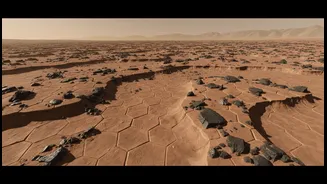
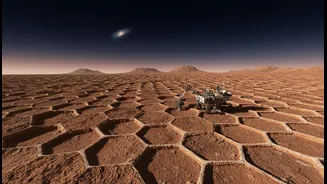
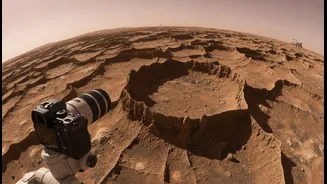
While climbing the foothills of Mount Sharp within Gale Crater, the Curiosity rover encountered a terrain that surprised mission scientists. From orbit, the area appeared bright and uniform, but on the ground, it revealed a network of raised, rocky ridges
forming interlocking polygons. These shapes, stretching across a nearly uninterrupted rock surface, create a striking honeycomb effect. While polygonal patterns have been seen on Mars before, the scale and clarity of this formation are unique, presenting a new geological mystery. Scientists are now trying to determine how these unusual structures came to be, a process that could reveal crucial details about Mars' distant past.
Unlocking Clues with Lasers and Lenses
To solve this puzzle, Curiosity is equipped with a sophisticated toolkit. Two key instruments are the Chemistry and Camera (ChemCam) and the Mars Hand Lens Imager (MAHLI). ChemCam uses a powerful laser to vaporize tiny specks of rock from a distance, creating a flash of plasma. The instrument then analyzes the light from this plasma to identify the chemical elements within the rock. This allows scientists to understand the rock's composition without even touching it. Following the laser analysis, MAHLI acts as a geologist's magnifying glass, providing highly detailed, close-up images of the rock's texture and mineral structure. Together, these tools provide a one-two punch of chemical and visual data, allowing the team back on Earth to piece together the history of the rocks they are studying.
What Could Form a Honeycomb?
On Earth, similar patterns can form through several processes. The most common is the repeated wetting and drying of mud, like in a seasonal lakebed. As mud dries, it shrinks and cracks; if this cycle happens repeatedly, the initial T-shaped cracks can evolve into more complex Y-shapes, eventually forming a hexagonal, honeycomb-like pattern. Other possibilities include the thermal contraction of rock or mineral crystallization. A leading hypothesis for these Martian honeycombs is that ancient mud cracks were later filled in by sediment that became cemented, possibly by salts, making them more resistant to erosion than the surrounding rock. Finding conclusive evidence of repeated wet-dry cycles would be a major discovery, suggesting a more stable and potentially seasonal climate on ancient Mars.
Searching for Water's Ancient Signature
The investigation into the honeycomb terrain is part of Curiosity's primary mission: to determine if Mars ever had the right environmental conditions to support microbial life. Evidence of sustained water is a key part of that. These honeycomb structures, especially if they are confirmed to be ancient mud cracks from a recurring lake or shoreline, would point to a persistent, cyclical climate rather than just sporadic, short-lived water events. The rover's journey up Mount Sharp has been a trip through time, with lower, older layers rich in clays formed in water, and upper layers showing more sulfates, minerals left behind as water dries up. These honeycombs, found in a transitional zone, could hold the story of exactly how and when Mars began to dry out, transforming from a potentially habitable world into the cold, arid planet we see today.
Mysterious Neighbors: The Dark Rocks
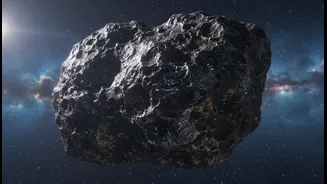
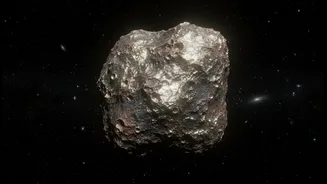
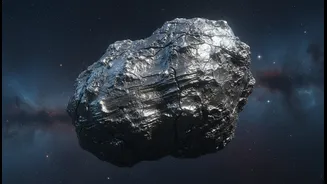
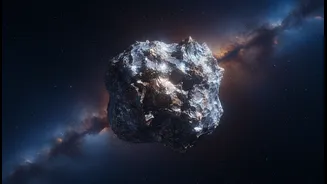
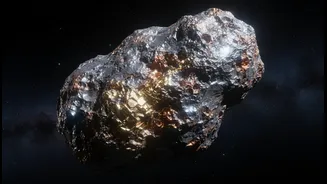
Adding another layer to the mystery, the honeycomb terrain is littered with dark, pebble-to-cobble-sized rocks of unknown origin. Scientists are pondering several theories: they could be fragments that rolled down from younger rock layers higher up on Mount Sharp, debris ejected from a distant meteorite impact, or even meteorites themselves that fell from space. A tantalizing clue comes from preliminary analysis of similar dark rocks found nearby, which showed the presence of nickel. On Earth, nickel is often associated with meteorites, but it is less common in native Martian rocks. Curiosity's instruments will continue to analyze these dark stones alongside the honeycombs to determine if they are related or simply two different geological puzzles sharing the same space.