

Reading Atmospheres from Light-Years Away
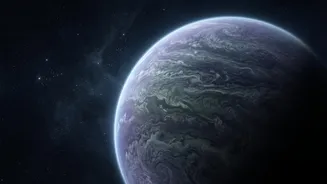
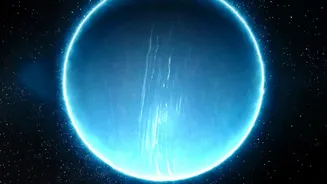
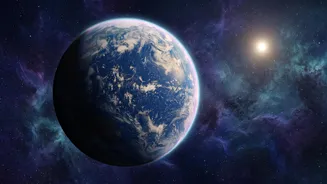
When astronomers study a distant exoplanet, they are essentially cosmic detectives looking for clues. One of the richest sources of information is the planet's atmosphere. By analysing the light from the planet's host star as it passes through the atmosphere,
scientists can look for the chemical 'fingerprints' of different gases. This method, known as transmission spectroscopy, allows them to identify molecules like water, methane, and carbon dioxide. These atmospheric components can tell us about a planet's climate, its geology, and most tantalizingly, whether it might harbour life. However, interpreting these fingerprints is incredibly complex. A planet's atmosphere is not a static envelope of gas; it is a dynamic, churning system influenced by countless factors, including the very star it orbits.
The Star as a Chemical Sculptor
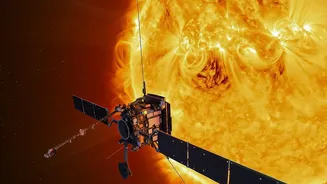
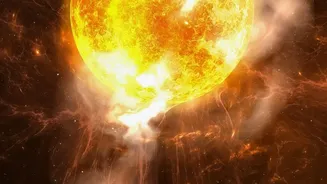
A star is more than just a source of heat and light for its planets; it's an active chemical engine. The high-energy ultraviolet and X-ray radiation that a star emits can trigger chemical reactions in a planet's atmosphere—a process known as photochemistry. This is not unlike how sunlight can cause sunburn on our skin or fade the colours in a photograph. In an exoplanet's atmosphere, this intense starlight can break apart molecules, rearrange atoms, and create entirely new compounds that might not exist otherwise. For years, scientists have understood this process, but new research is revealing that this stellar influence is far more significant than previously thought. It doesn't just change the atmosphere; it imprints a unique, lasting signature upon it.
A New Understanding of Planetary Fingerprints
Recent findings have shown that this process of photochemistry is a crucial piece of the puzzle. For example, the detection of sulfur dioxide in the atmosphere of the gas giant WASP-39 b provided the first concrete evidence of active photochemistry on an exoplanet. This molecule could only have been formed by chemical reactions powered by the host star's light. This discovery highlights a critical point: the chemical makeup of a planet's atmosphere is a direct consequence of its interaction with its star. The specific type and intensity of a star's light, combined with the initial gases in the planet's atmosphere, creates a unique chemical profile. This profile—this photochemical fingerprint—can give scientists a much clearer picture of the planet's conditions and history.
Avoiding Cosmic False Positives
One of the biggest challenges in the search for extraterrestrial life is the problem of 'false positives'. Many gases that could be signs of life, known as biosignatures, can also be produced by non-biological processes. For instance, oxygen, a key byproduct of photosynthesis on Earth, can also accumulate in a planet's atmosphere through purely photochemical reactions if intense starlight breaks down water molecules and the lighter hydrogen escapes to space. By understanding the specific photochemical fingerprint a star leaves on its planet, scientists can better distinguish between a world where oxygen is produced by geology and starlight, and a world where it might be produced by life. This context is crucial for correctly interpreting the data sent back by telescopes like the James Webb Space Telescope (JWST).
The Future of Exoplanet Exploration
This evolving understanding of solar chemistry is already shaping the future of astronomy. As we build more powerful observatories, like the planned Habitable Worlds Observatory, the ability to decode these complex chemical fingerprints will be essential. Scientists are now developing sophisticated models that incorporate a star's unique light spectrum to predict what a planet's atmosphere should look like without life. By comparing these models to actual observations, they can spot anomalies—gases or chemical imbalances that don't fit the expected photochemical profile. These anomalies could be the most promising targets in the search for life beyond Earth, turning the star from a source of potential confusion into a vital tool for discovery.