





A Landmark Trial Begins
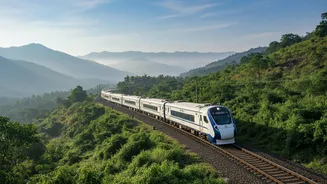
The South Western Railway's Mysuru Division has officially started field trials for the much-anticipated Vande Bharat Express connecting Bengaluru with the coastal city of Mangaluru. A specially manufactured 20-car rake, built by the Integral Coach Factory
in Chennai, arrived in the region last week for these tests. After initial static checks, the train began its dynamic trials on the formidable Sakleshpur-Subrahmanya Road ghat section on August 12. Personnel from the Research Designs and Standards Organisation (RDSO) are on board to monitor every aspect of the train's performance, marking a critical phase before the service can be deemed safe for passengers.
The Ultimate Ghat Challenge
This isn't just any railway line; it's an engineering marvel and a logistical puzzle. The 55-kilometre stretch between Sakleshpur and Subrahmanya Road is renowned for its difficulty, cutting through the dense Western Ghats. The route features a steep gradient of 1 in 50, meaning the track rises or drops one metre for every 50 metres travelled. It also includes 57 tunnels, 226 bridges, and over 100 sharp curves. This terrain is not only challenging for maintaining speed but is also highly susceptible to landslides, especially during the monsoon season. For a semi-high-speed train like the Vande Bharat, ensuring safety here is the highest priority.
What the Safety Tests Involve
The ongoing trials, scheduled to continue until August 20, are designed to test the limits of the train in this unique environment. The Commissioner of Railway Safety (CRS) has capped the maximum speed on this stretch at a cautious 30 kmph. The key system under evaluation is a specially fitted Automatic Emergency Braking (AEB) system. This technology is crucial because conventional trains often use additional 'banker' locomotives to help push them up steep inclines, a method unsuitable for the integrated Vande Bharat trainsets. The RDSO team is meticulously assessing acceleration on gradients, braking efficiency, stability through sharp turns, and the overall response of the AEB system to ensure it can operate safely without external assistance.
A Game-Changer for Karnataka's Connectivity
Should these trials prove successful, the introduction of the Vande Bharat service would revolutionise travel between the state capital and the coastal region. The new service is expected to significantly reduce travel time compared to existing train and bus options, providing a faster, more comfortable journey. This improved connectivity promises a major boost for tourism, business, and daily commuters, seamlessly linking key economic hubs. The project's success hinges on conquering the ghat section, which has long been the primary obstacle to faster rail service on this vital corridor.
The Path Forward
While the commencement of trials has generated considerable excitement, railway officials are clear that this is just one step in a longer process. A launch had previously been anticipated by June 2026 but was delayed pending the availability of a rake equipped with the necessary AEB system. After the trials conclude, the RDSO will submit its detailed findings. A final safety clearance from the Commissioner of Railway Safety is mandatory before the Ministry of Railways can officially announce the service, including its schedule and fare structure. If all goes well, passengers could soon be enjoying a swift and scenic journey through the Ghats, marking a new chapter in Indian Railways' expansion.