



A Portrait of a Dying Star
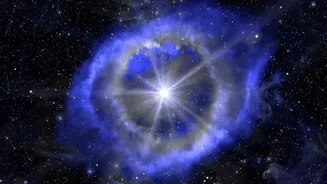
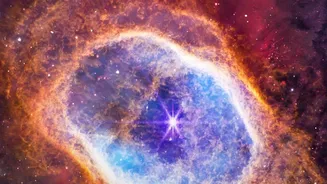
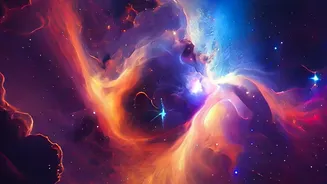
At first glance, the image of the Lion Nebula, officially known as NGC 2392, is captivating. In the centre sits a tiny, bright point—the ‘nose’ of the lion. This is a white dwarf, the incredibly hot and dense core of a star that has shed its outer layers.
Surrounding it is a bubble of purple and pink gas, forming the lion’s ‘face’. This inner shell is being blasted by intense radiation from the white dwarf, causing it to expand and glow. The most striking feature is the outer ‘mane,’ a chaotic ring of gas and dust filaments. Webb’s image reveals these structures in stunning detail, showing comet-like tails and clumps of material that have so far survived the central star's energetic onslaught.
Webb's Unparalleled Infrared Vision
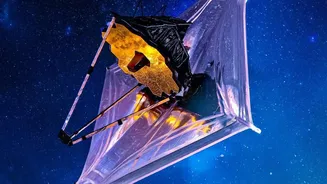
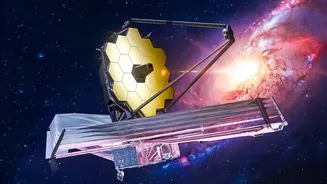
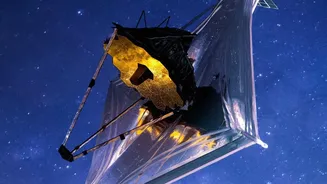
While the Hubble Space Telescope gave us our first incredible look at the Lion Nebula years ago, the James Webb Space Telescope sees the universe in a different light—literally. By observing in near- and mid-infrared wavelengths, Webb can pierce through the clouds of gas and dust that obscure the view of other telescopes. This allows it to reveal hidden details with much greater clarity. In this new portrait, Webb highlights the contrast between the hot, ionized gas being carved out by the star and the resilient, cooler clumps of dust in the mane. It’s this ability to see the interplay of different materials and temperatures that makes Webb’s view so scientifically valuable.
The Science of a Stellar Finale
The Lion Nebula is what astronomers call a planetary nebula—not because it has planets, but because of its round, planet-like appearance through early telescopes. It represents the end-of-life phase for stars similar in mass to our Sun. After billions of years of burning fuel, the star becomes unstable and puffs its outer layers into space. The remaining core collapses into a white dwarf. This stellar remnant is so hot that its ultraviolet radiation ionizes the surrounding gas, causing it to light up like a cosmic neon sign. The process creates the beautiful, complex structures of rings and shells we see, sculpted by the dying star's final, powerful gasps.
A Fleeting Cosmic Masterpiece
Though it appears frozen in the stunning image, the Lion Nebula is a dynamic and rapidly changing environment. It has taken several thousand years for the gas and dust to be shaped into this form, and the process is far from over. The bubble of gas is constantly expanding, destroying dust in its path while the stellar winds from the white dwarf continue to sculpt the mane. Astronomers estimate that the entire nebula will disperse into interstellar space in about 10,000 years. In astronomical terms, this is an incredibly short period. Webb's image is therefore a precious snapshot, capturing a fleeting moment of beauty in the life cycle of a star.
Why This Distant Roar Matters to Us
Studying a dying star thousands of light-years away might seem abstract, but it makes the concept of stellar evolution deeply relevant. Most stars in our galaxy, including our own Sun, will end their lives in a similar fashion. Looking at the Lion Nebula is like getting a preview of our solar system's fate in the very distant future. These stellar deaths are not just endings; they are also acts of creation. The elements forged inside the star are cast out into the cosmos, enriching the interstellar medium with the raw materials needed for new stars, planets, and even life. By understanding this process in detail, we learn more about our own cosmic origins and the universe's grand cycle of death and rebirth.